
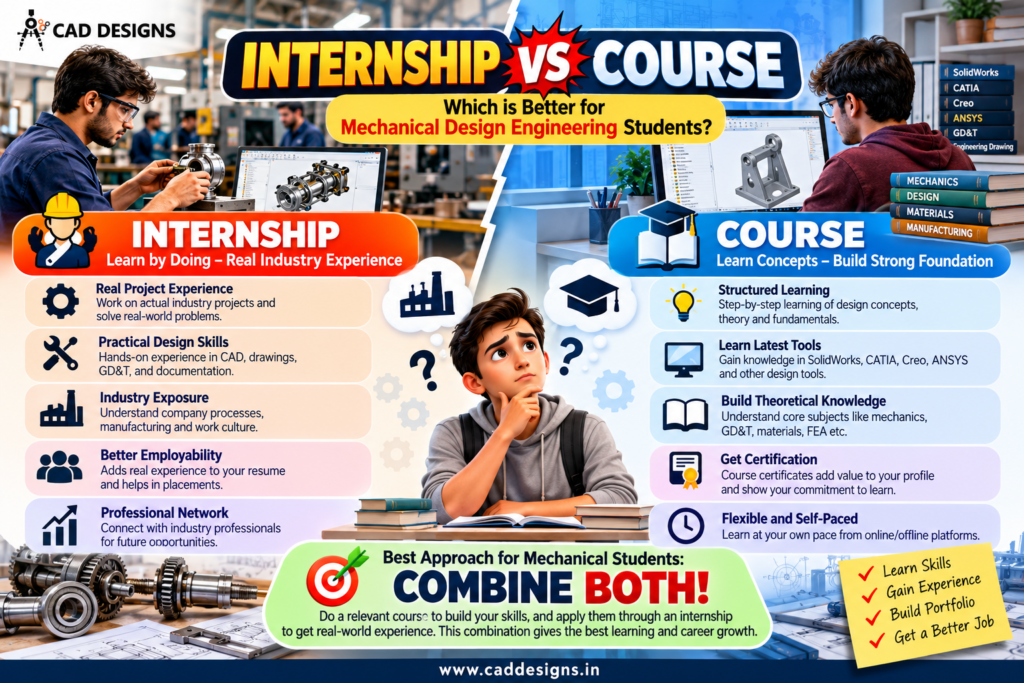
For a mechanical engineering student who wants to build a career in Mechanical Design Engineering, one common question is:
“Should I take a CAD/design course or join an internship?”
Both can help you start your career, but they serve different purposes.
A course teaches you the skills and concepts you need, while an internship gives you an opportunity to apply those skills in a real engineering environment.
So instead of simply asking Internship vs Course—which is better?, a better question is:
How can I use both to become a job-ready Mechanical Design Engineer?
Let’s understand the difference.
🎓 What Does a Mechanical Design Course Give You?
A good mechanical design course provides structured learning. It is particularly useful for students who are new to CAD, CAE, GD&T, engineering drawings, or product design.
Depending on your career goal, a course may cover tools such as:
AutoCAD
SolidWorks
CATIA
Creo
Siemens NX
ANSYS
GD&T
Engineering Drawing
Design calculations
Finite Element Analysis (FEA)
Product design fundamentals
✅ Advantages of Taking a Course
1. Structured Learning
Instead of learning random commands from different sources, a well-designed course takes you from basic concepts to more advanced applications step by step.
2. Stronger Fundamentals
Software knowledge alone does not make someone a good design engineer.
Students also need to understand concepts such as tolerances, fits, materials, manufacturing processes, GD&T, design calculations and engineering drawings.
3. Opportunity to Learn Industry Software
Courses can help students become familiar with CAD/CAE tools commonly used for mechanical design.
4. Certification
A relevant certificate can support your resume, particularly when you are a fresher. However, the skills behind the certificate are much more important than the certificate itself.
5. Flexible Learning
Online and offline courses allow students to learn at their own pace and repeatedly practise difficult concepts.
🏭 What Does a Mechanical Design Internship Give You?
An internship is about learning by doing.
Instead of only studying how a component should be designed, you may get exposure to how actual engineering teams design, modify, manufacture, inspect and document components.
✅ Advantages of an Internship
1. Real Project Experience
An internship can expose you to practical engineering problems that are difficult to experience through classroom learning alone.
For example:
A CAD model may look perfect on your computer, but can it actually be manufactured economically?
That is where practical exposure becomes valuable.
2. Practical Design Skills
Depending on the company and internship role, you may learn how engineers handle:
3D modelling
Assemblies
2D manufacturing drawings
GD&T
Design modifications
BOM preparation
Design reviews
Documentation
Engineering Change Requests
Manufacturing feedback
Quality requirements
These experiences help connect theoretical knowledge with actual engineering work.
3. Understanding Industry Workflow
Engineering in a company is rarely an individual activity.
A design engineer may need to interact with manufacturing, quality, procurement, suppliers, testing teams and customers.
An internship can help students understand these workflows.
4. Better Portfolio and Resume
Writing only:
“Completed SolidWorks Course”
is different from being able to explain:
“Designed an assembly, prepared manufacturing drawings, created a BOM and modified the design based on manufacturing requirements.”
Project experience gives recruiters something practical to discuss during an interview.
5. Professional Networking
Internships can also help you interact with experienced engineers, managers and other professionals.
Those connections may become useful later for career guidance and opportunities.
⚙️ Internship vs Course: Quick Comparison
| Factor | Course 🎓 | Internship 🏭 |
|---|---|---|
| Main Purpose | Learn skills and concepts | Apply skills in practice |
| CAD Software Learning | ⭐⭐⭐⭐ | Depends on company/role |
| Theoretical Knowledge | ⭐⭐⭐⭐ | Usually limited |
| Practical Experience | ⭐⭐ | ⭐⭐⭐⭐⭐ |
| Real Projects | Sometimes | Usually |
| Industry Exposure | Limited | High |
| Certification | Usually available | Often available |
| Professional Networking | Limited | High |
| Flexibility | High | Lower |
| Resume Value | Useful | Strong when experience is relevant |
| Best For | Building skills | Applying skills |
 So, Which Is Better for Mechanical Engineering Students?
There is no need to treat them as competitors.
For many students, the strongest approach is:
🎯 COURSE + INTERNSHIP
Think about it like this:
Course → Learn → Practice → Build Projects → Internship → Gain Experience → Build Portfolio → Apply for Jobs
A course can give you the technical foundation.
An internship can teach you how those skills are applied under real engineering constraints.
Together, they can provide a much stronger learning path.
🚀 Recommended Roadmap for a Mechanical Design Student
Step 1: Strengthen Mechanical Fundamentals
Before concentrating entirely on software, develop a good understanding of:
Engineering drawing
Machine design
Strength of materials
Manufacturing processes
Materials
Tolerances and fits
GD&T basics
Step 2: Learn One Major 3D CAD Tool Properly
You don’t need to learn every CAD package at the beginning.
Choose one suitable tool such as:
SolidWorks / CATIA / Creo / Siemens NX
Learn:
Sketching → Part Modelling → Assemblies → Drafting → Sheet Metal/Surfacing as required
Once you understand design concepts properly, learning another CAD package becomes easier.
Step 3: Learn GD&T and Manufacturing Drawings
A beautiful 3D model alone is not enough.
A Mechanical Design Engineer should understand how to communicate design intent through drawings.
Learn:
Datums
Feature control frames
Form tolerances
Orientation tolerances
Location tolerances
Fits and clearances
Surface finish
Manufacturing considerations
Step 4: Build 3–5 Strong Projects
Instead of filling your resume with many certificates, create projects you can actually explain.
Examples include:
🔧 Gearbox assembly
⚙️ Bearing housing
🏗️ Mechanical fixture
🔩 Shaft and coupling assembly
🚗 Automotive component
🏭 Machine mechanism
📐 Sheet-metal enclosure
For each project, try to include:
3D Model + Assembly + 2D Drawing + GD&T + BOM + Design Explanation
Step 5: Apply for a Relevant Internship
Don’t choose an internship only because it provides a certificate.
Look for opportunities where you can gain exposure to:
CAD modelling
Product design
Tool design
Machine design
Manufacturing
FEA
Automotive design
Quality engineering
Engineering documentation
Step 6: Create Your Mechanical Design Portfolio
A good portfolio can show employers what you can actually do.
Include your best work with:
Project objective
CAD screenshots
Exploded views
Drawings
Design calculations
Material selection
Manufacturing considerations
Challenges faced
Final solution
⚠️ Don’t Make These Common Mistakes
Many students spend months collecting certificates but have difficulty explaining a simple mechanical design during an interview.
Others join internships where they receive very little actual engineering exposure.
Avoid both situations.
❌ Don’t collect certificates without developing skills.
❌ Don’t learn only CAD commands.
❌ Don’t ignore engineering fundamentals.
❌ Don’t join an internship only for the certificate.
❌ Don’t copy projects without understanding them.
❌ Don’t try to learn every CAD software package simultaneously.
Instead:
✅ Learn the fundamentals.
✅ Master one CAD package.
✅ Practise with realistic projects.
✅ Understand manufacturing.
✅ Learn GD&T.
✅ Gain relevant industry exposure.
✅ Build a portfolio that demonstrates your skills.
💡 What Do Companies Really Look For?
For entry-level Mechanical Design Engineering roles, employers may look for a combination of technical knowledge, CAD ability, problem-solving skills and communication.
You should be prepared to answer questions such as:
Why did you choose this material?
How will this component be manufactured?
Why is this tolerance required?
How will the assembly work?
What happens if this dimension changes?
How would you reduce the weight or manufacturing cost?
What design problem did you solve in your project?
Knowing where a CAD command is located is useful.
Knowing why a component is designed in a particular way is what starts developing you into an engineer.
🏆 Final Takeaway
Course teaches you HOW.
Internship shows you WHERE and WHY those skills are used.
For Mechanical Design Engineering students, a strong career path is therefore:
📚 Learn → 💻 Practise → 🛠️ Build → 🏭 Experience → 📁 Portfolio → 💼 Job
Don’t choose between knowledge and experience if you have the opportunity to build both.
🎯 Learn Skills + Gain Experience + Build a Portfolio
That combination can make you much better prepared for your first Mechanical Design Engineering opportunity.
🔧 CAD DESIGNS
Learn Mechanical Design. Improve Your Engineering Skills. Build Your Career.
Visit: www.caddesigns.in