
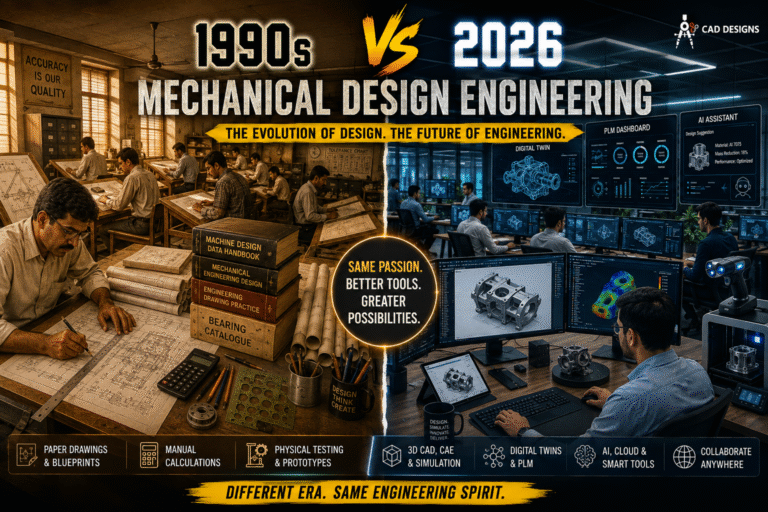
Mechanical design engineering has changed dramatically over the last three decades.
For engineers who began their careers in the 1990s, designing a component often meant standing in front of a drafting board, sharpening pencils, referring to thick engineering handbooks, performing calculations manually, and carrying large drawing sheets from one department to another.
Fast-forward to 2026.
Today, the same engineer may create a complete 3D assembly, run simulations, collaborate with a team thousands of kilometres away, manage revisions digitally, and even use AI-assisted engineering tools—all from a workstation or laptop.
The fundamentals of engineering haven’t disappeared. The tools have changed.
Here are 15 nostalgic 1990s vs 2026 comparisons that show the incredible evolution of Mechanical Design Engineering.
1. Drafting Board vs 3D CAD
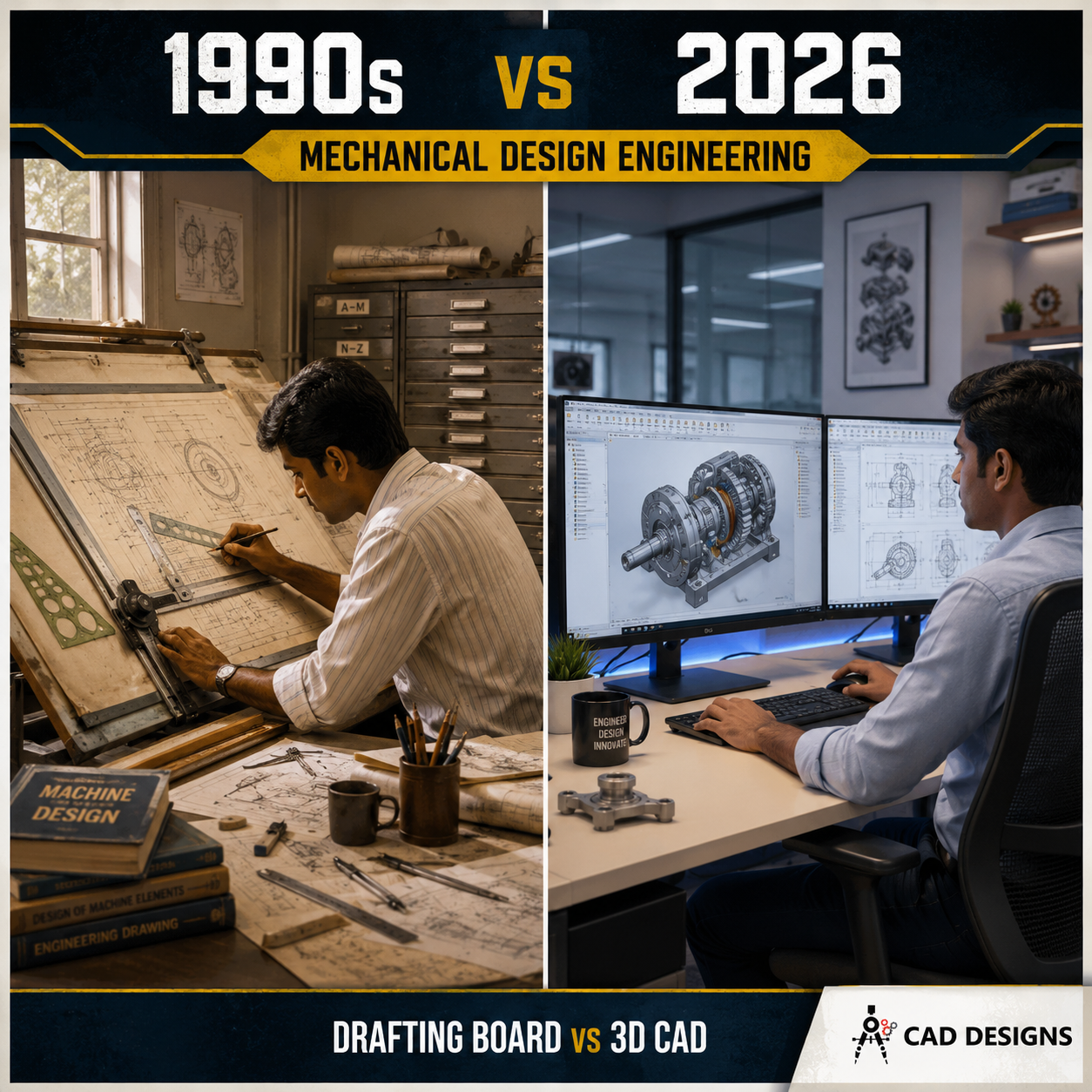
1990s: The Drafting Board Era
Before CAD became standard across engineering companies, drafting boards were at the heart of mechanical design departments.
Engineers and draftsmen worked with T-squares, mini-drafters, set squares, compasses, scales, pencils and erasers to produce detailed engineering drawings.
A small modification could mean erasing and redrawing several portions of a drawing.
2026: The 3D CAD Era
Today, engineers develop parametric 3D models using modern CAD systems. Components can be modified, assembled, analysed and converted into manufacturing drawings digitally.
A dimensional change can automatically propagate through related features, drawings and assemblies.
Then: Pencil + Drawing Board
Now: Mouse + Keyboard + 3D CAD
2. Manual Assembly Drawings vs Digital 3D Assemblies
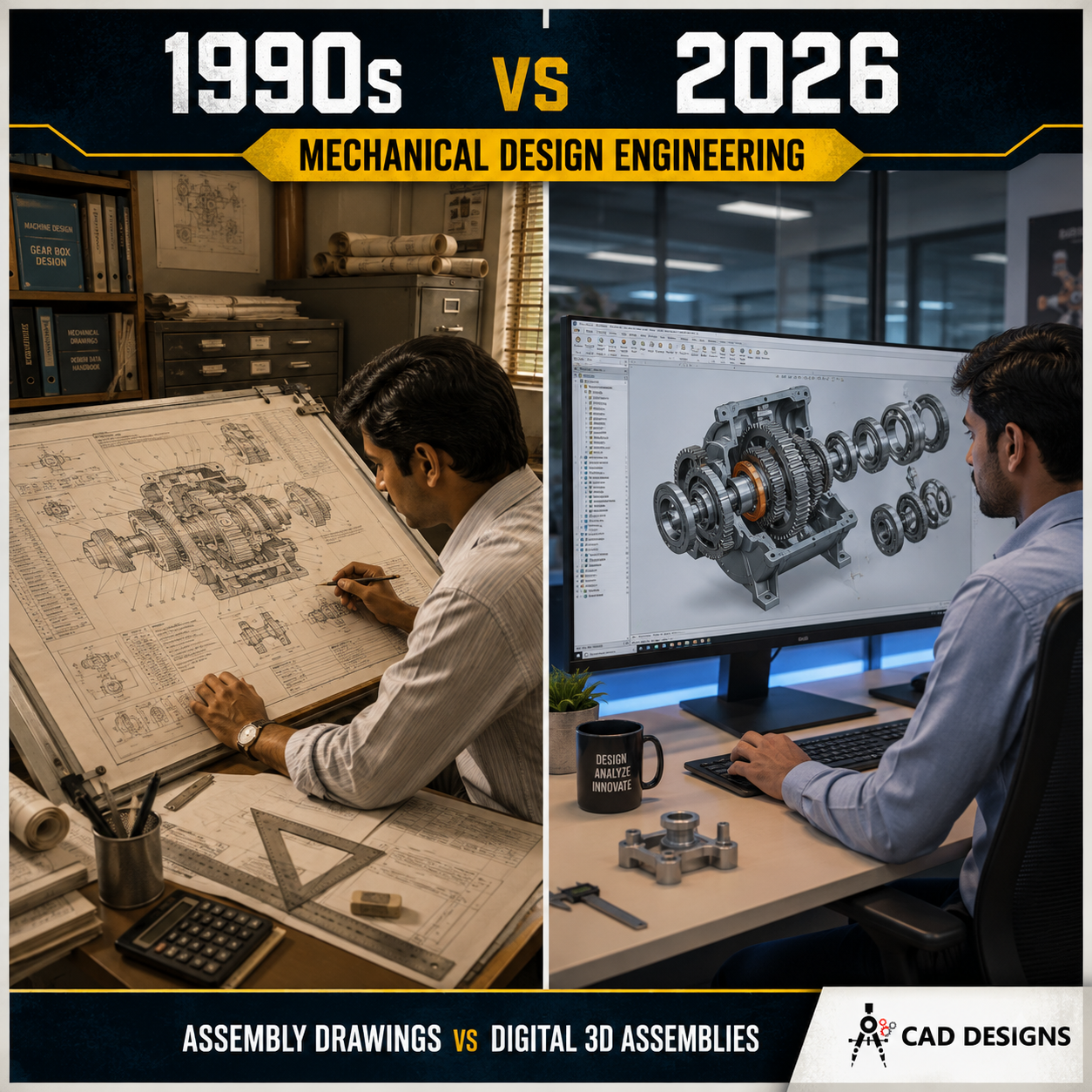
Imagine creating a complicated gearbox assembly without being able to rotate it on a screen.
That was normal engineering work for many designers.
In the 1990s, engineers relied heavily on orthographic, sectional and exploded drawings to understand assemblies.
Today, designers can rotate, section, hide and isolate components within a digital 3D assembly.
Interference and clearance issues can often be identified before a single physical component is manufactured.
Same engineering principles. Completely different visualization experience.
3. Drawing Cabinets vs PLM and Cloud Storage
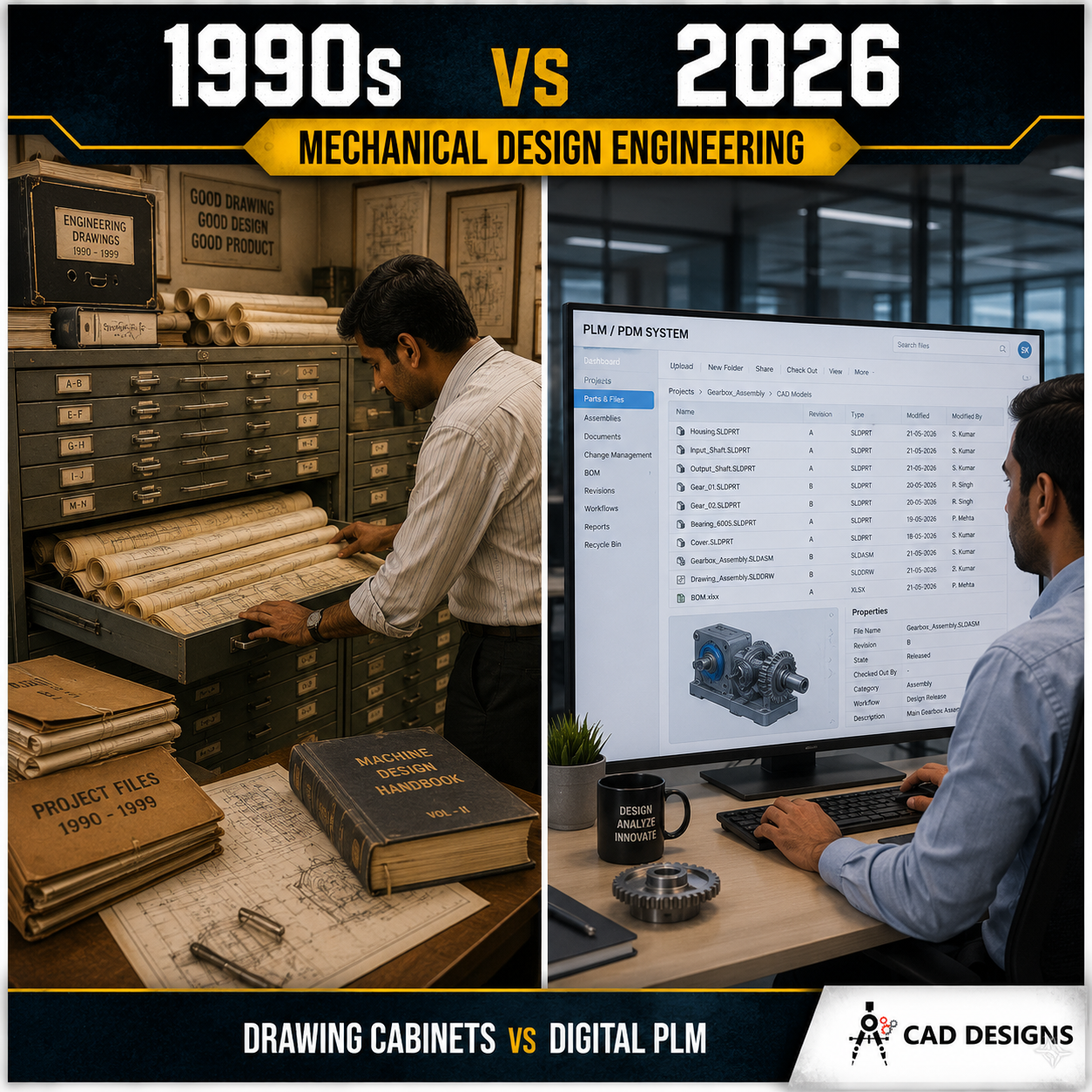
Mechanical design departments once required enormous storage cabinets.
Thousands of component drawings, assembly drawings, specifications and revision documents had to be physically organized.
Finding an old drawing could itself become a task.
In 2026, engineering drawings and models can be stored and managed through digital document-management and Product Lifecycle Management systems.
Search.
Open.
Check revision.
Continue designing.
The drawing room became a database.
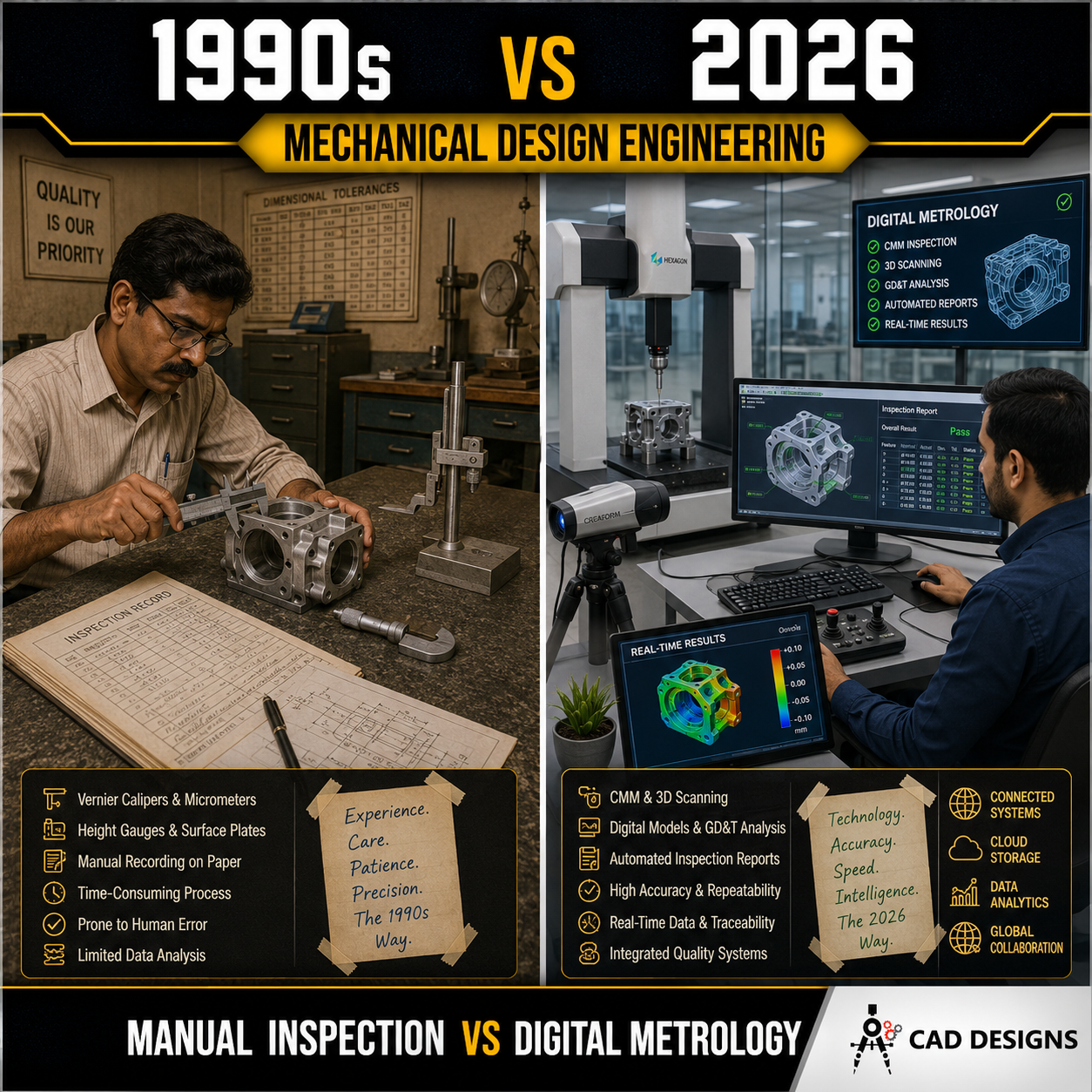
4. Manual Inspection vs Digital Metrology
Quality engineers traditionally relied heavily on tools such as:
Vernier calipers, micrometers, height gauges, dial indicators, slip gauges and surface plates.
These instruments remain extremely important even today.
However, modern manufacturing has added technologies such as CMMs, digital measurement systems, optical inspection and 3D scanning.
Complex geometries that once required multiple manual measurements can now be digitally inspected against CAD geometry.
1990s: Measure the component.
2026: Measure it—and compare it directly with its digital model.
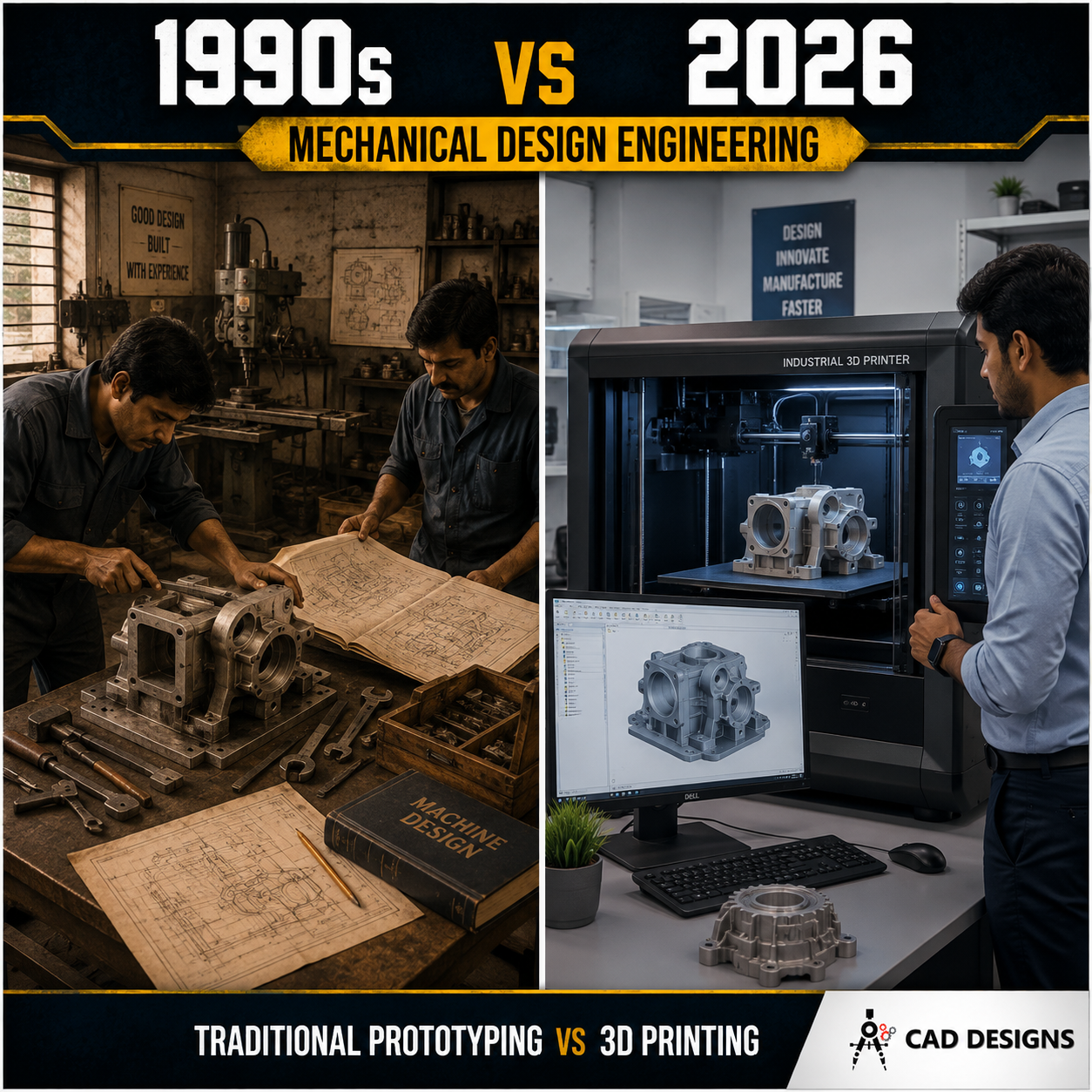
5. Traditional Prototypes vs 3D Printing
Creating a prototype once required considerable planning.
Depending on the product, engineers might need machining, fabrication, casting, woodworking or model-making.
That meant material, machines, skilled labour and significant lead time.
Today, additive manufacturing allows designers to turn CAD geometry into physical prototypes remarkably quickly.
This is especially valuable during early design iterations.
Design.
Print.
Test.
Modify.
Print again.
Rapid prototyping has fundamentally changed product development.
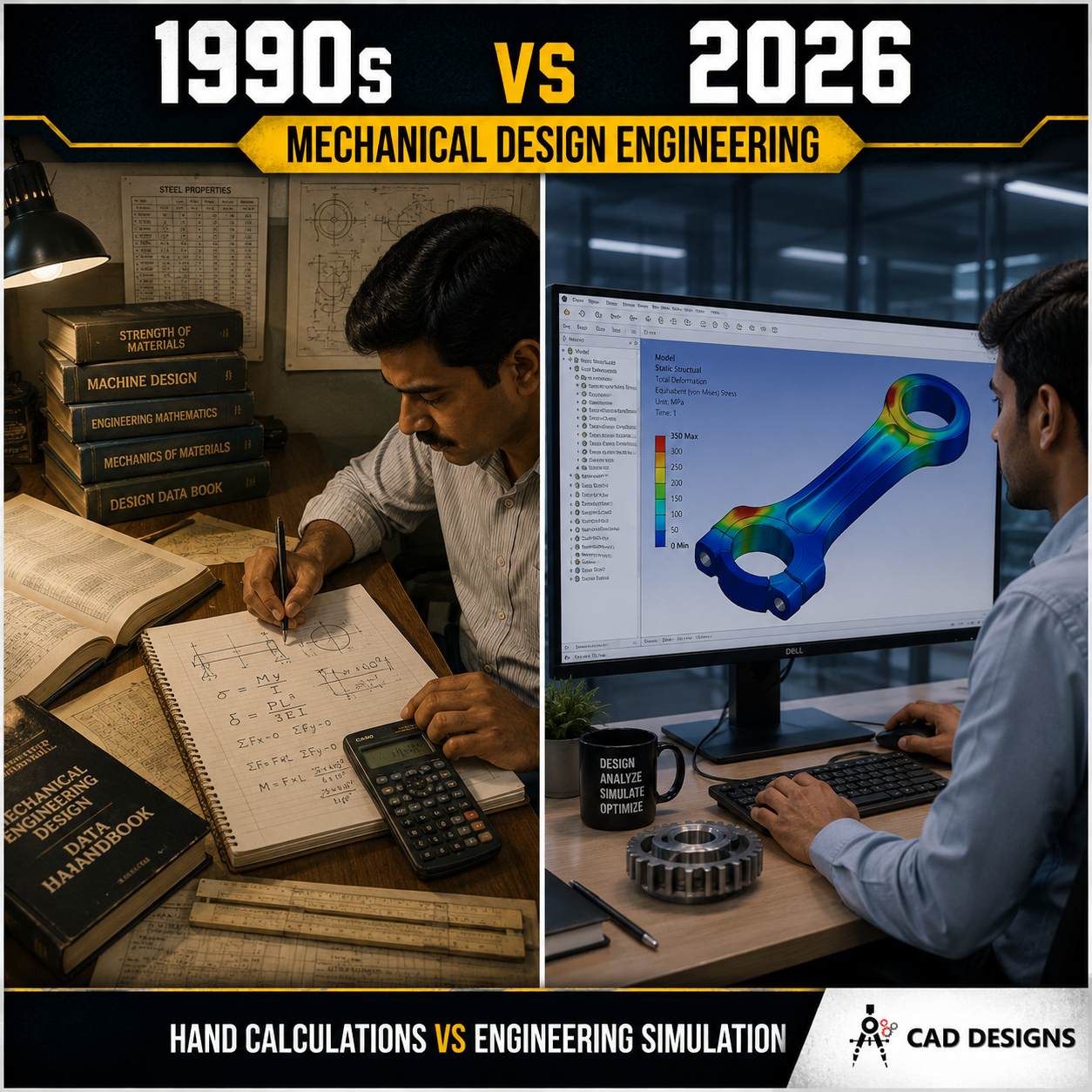
6. Hand Calculations vs Engineering Simulation
Remember engineering notebooks filled with calculations?
Design engineers relied on calculators, mathematical tables, charts, equations and engineering handbooks.
Those calculations built strong engineering intuition.
Today, computers can perform complex FEA, CFD, thermal and dynamic simulations involving thousands or millions of calculations.
But one principle remains unchanged:
Software can calculate the answer. The engineer must decide whether the answer makes sense.
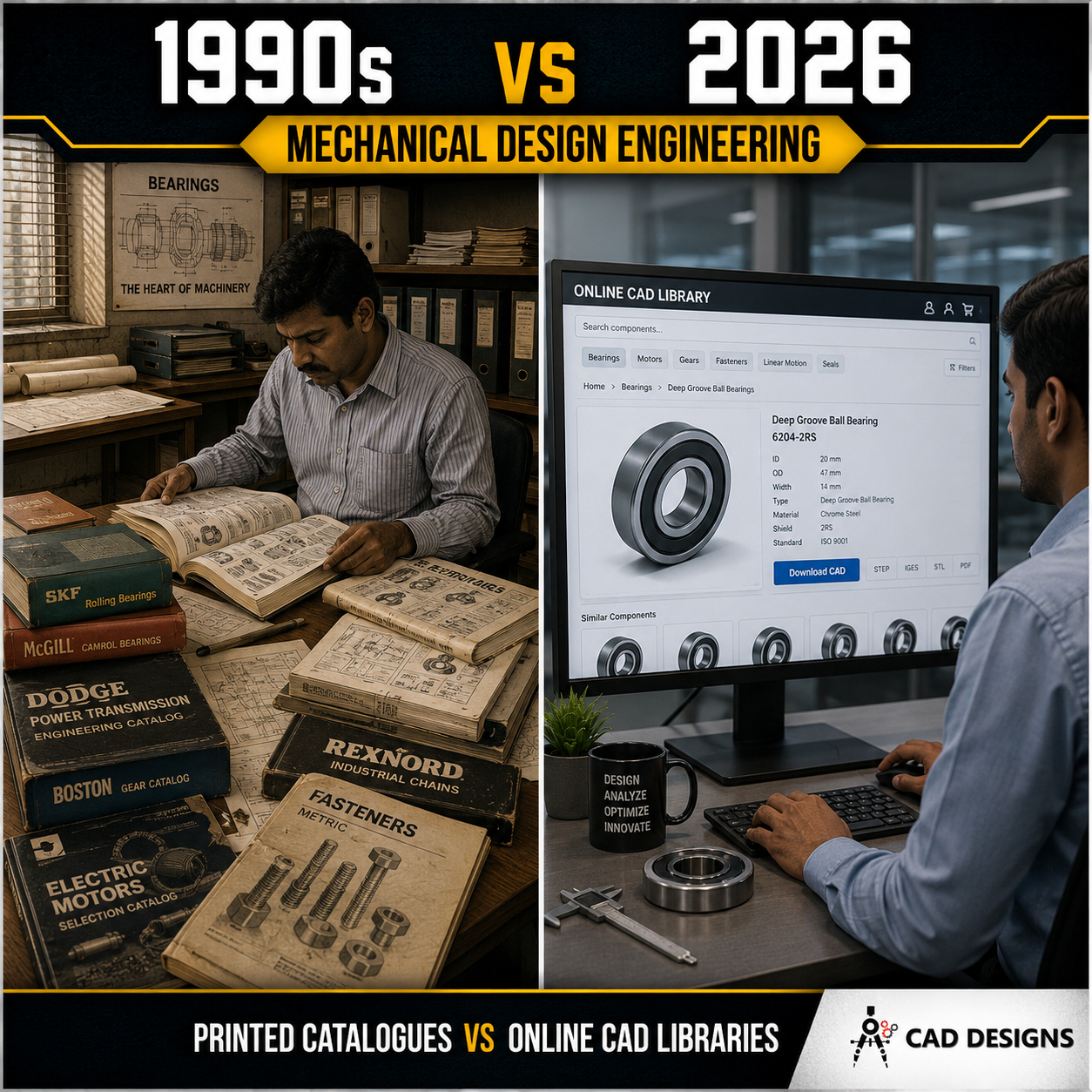
7. Thick Component Catalogues vs Online CAD Libraries
This one may bring back memories for many experienced engineers.
Manufacturers once supplied huge printed catalogues containing bearings, motors, gears, fasteners, cylinders, seals and other standard components.
Engineers would search through hundreds of pages looking for the correct specification.
Today, an engineer can often search for a component online and download its CAD model directly.
Remember keeping those massive catalogues beside your drafting table?
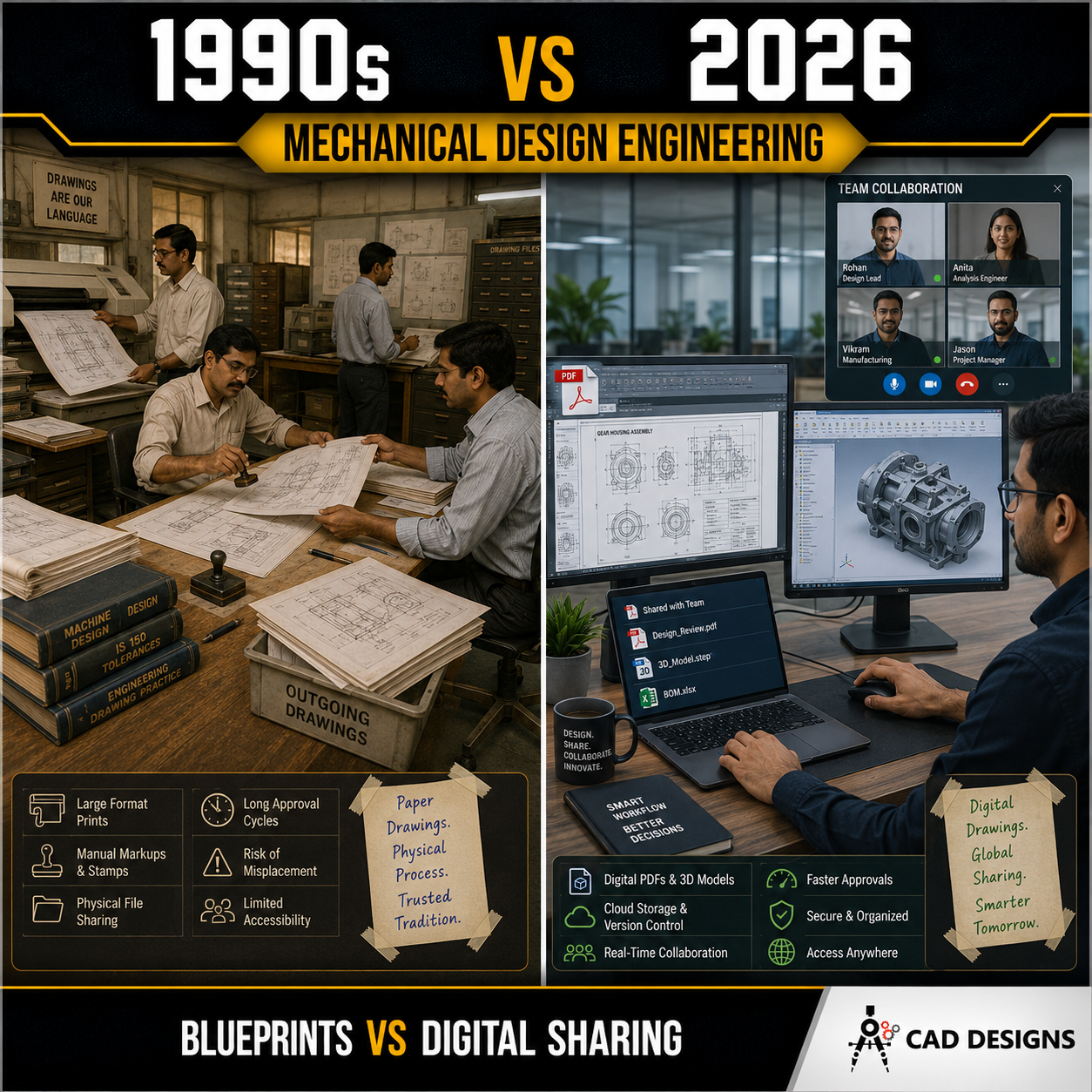
8. Blueprints and Large Prints vs PDFs and Digital Sharing
Large-format engineering drawings were once everywhere.
Drawings were printed, folded, stamped, signed and physically transferred between engineering, manufacturing, quality and suppliers.
Today, drawings can travel across the world almost instantly.
PDFs, CAD models and other engineering data can be shared digitally with manufacturing teams and suppliers.
The information is similar.
The speed of communication is completely different.
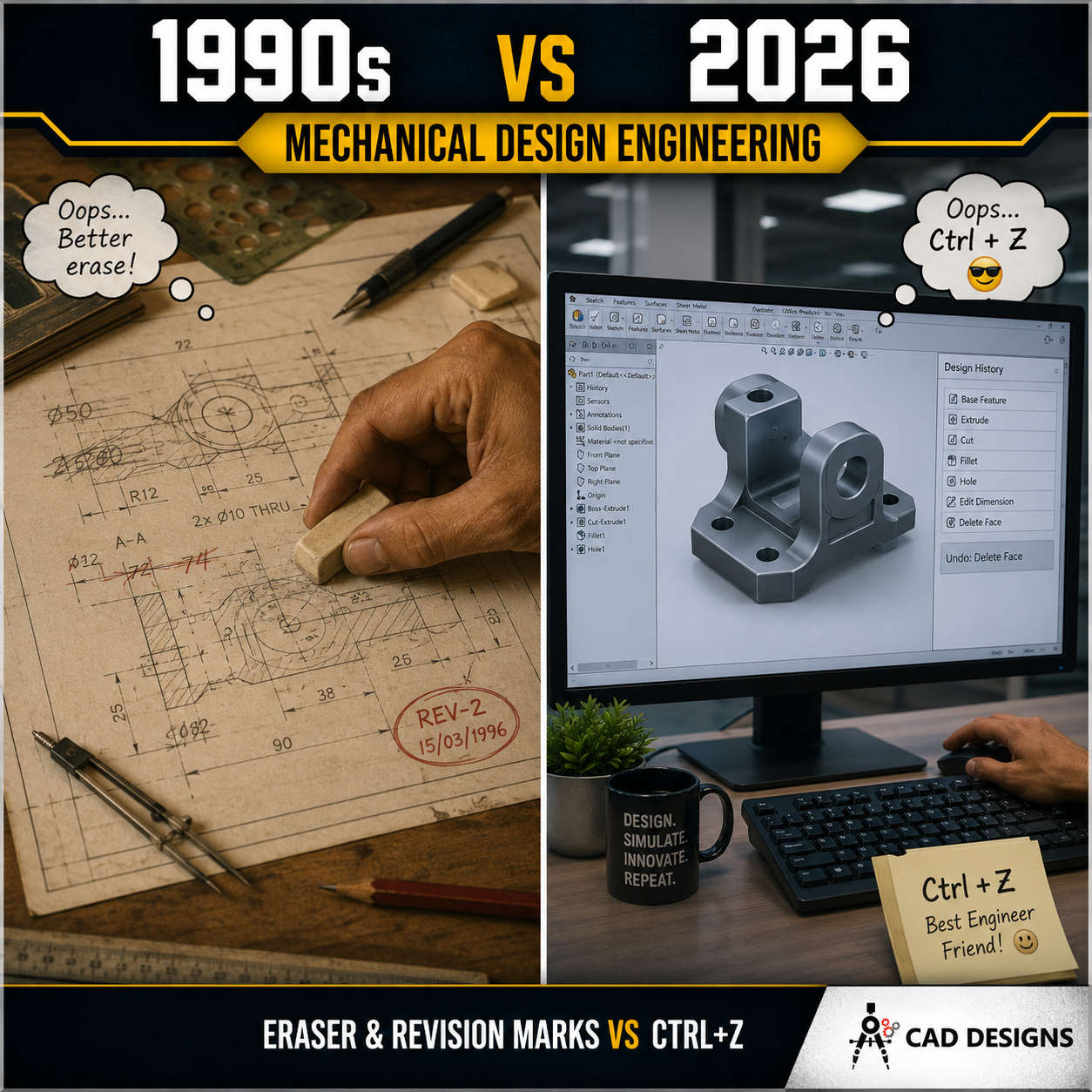
9. Eraser and Revision Marks vs Ctrl+Z and Version Control
Made a mistake on a manual drawing?
Take the eraser.
Made a major design change?
Things became more interesting.
Engineering changes could require substantial redrawing and careful revision control.
Today, CAD systems make editing significantly easier, while PDM/PLM systems help manage versions and revisions.
Perhaps one of the greatest inventions for modern designers is still very simple:
Ctrl + Z. 😄
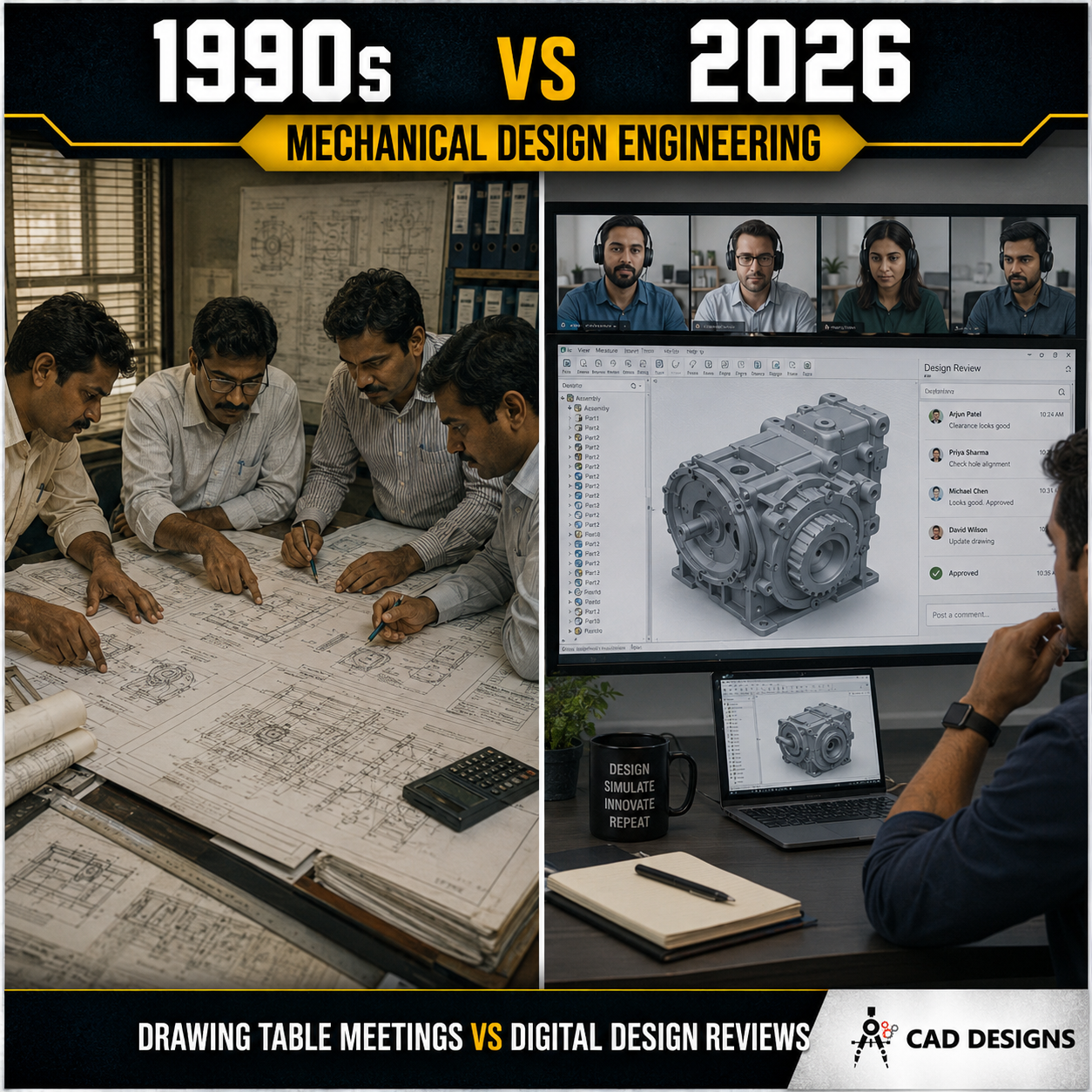
10. Drawing-Table Meetings vs Digital Design Reviews
Design reviews once meant gathering engineers around a large table covered with drawings.
People pointed at dimensions, marked drawings and discussed manufacturing problems face-to-face.
Those meetings were incredibly valuable—and still are.
But modern teams can now review the same 3D model from different locations.
Designers, manufacturing engineers, suppliers and customers can collaborate while looking at the same digital product.
The conference table became global.
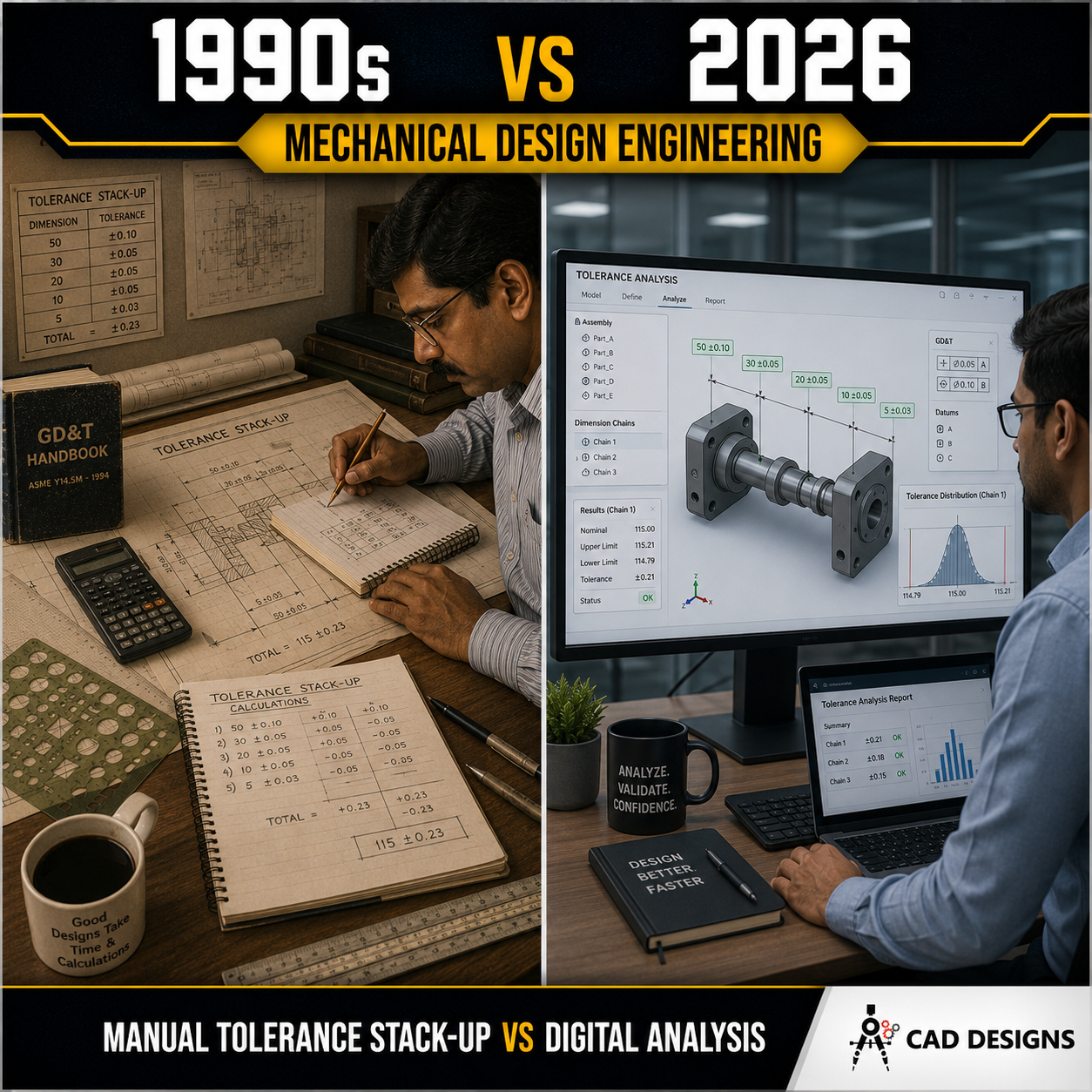
11. Manual Tolerance Stack-Up vs Digital Analysis
Tolerance analysis has always been one of the most important responsibilities of mechanical designers.
In earlier workflows, tolerance stack-ups were commonly calculated manually using drawings, equations and spreadsheets.
Modern engineering tools can assist with GD&T interpretation and tolerance analysis across increasingly complex assemblies.
But technology hasn’t eliminated the fundamental question:
Will all these parts actually assemble and function when manufacturing variation occurs?
That remains an engineering problem—not merely a software problem.
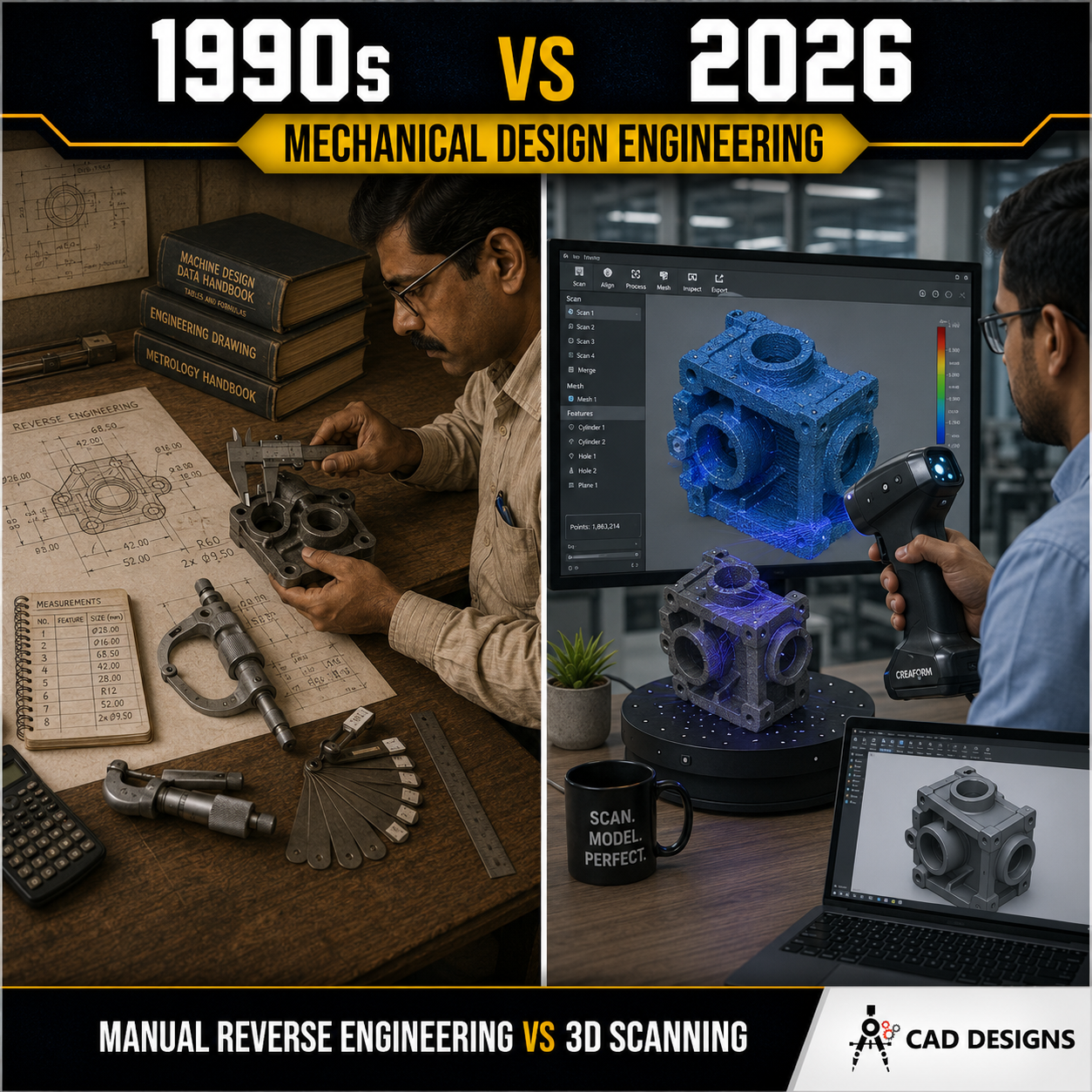
12. Manual Reverse Engineering vs 3D Scanning
Imagine receiving an old mechanical component with no drawing available.
Traditionally, engineers measured every important feature using calipers, micrometers, radius gauges and other instruments before manually recreating the geometry.
Today, 3D scanning can capture complex surfaces as point-cloud or mesh data that can assist the reverse-engineering process.
The engineer still needs to understand the component’s design intent.
Technology captures geometry. Engineering understands why that geometry exists.
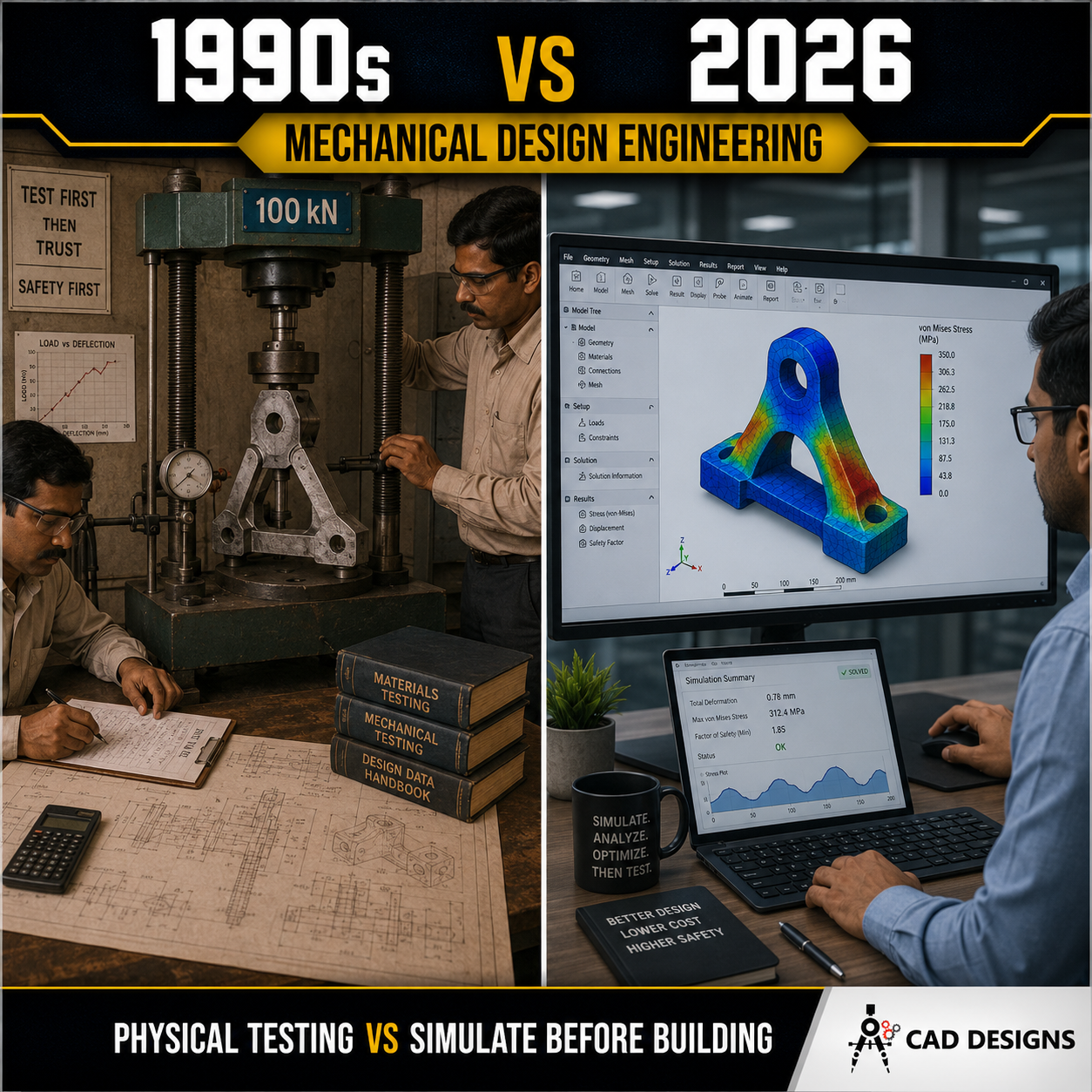
13. Build It and Test It vs Simulate Before Building
Physical testing has always been essential to engineering.
Historically, companies often needed physical prototypes relatively early to understand structural behaviour and potential failures.
Modern CAE allows engineers to investigate stresses, deformation, temperature, vibration, fluid flow and other behaviour before committing to expensive prototypes.
Physical validation remains crucial.
But now engineers can ask many “What if?” questions digitally before building the first test article.
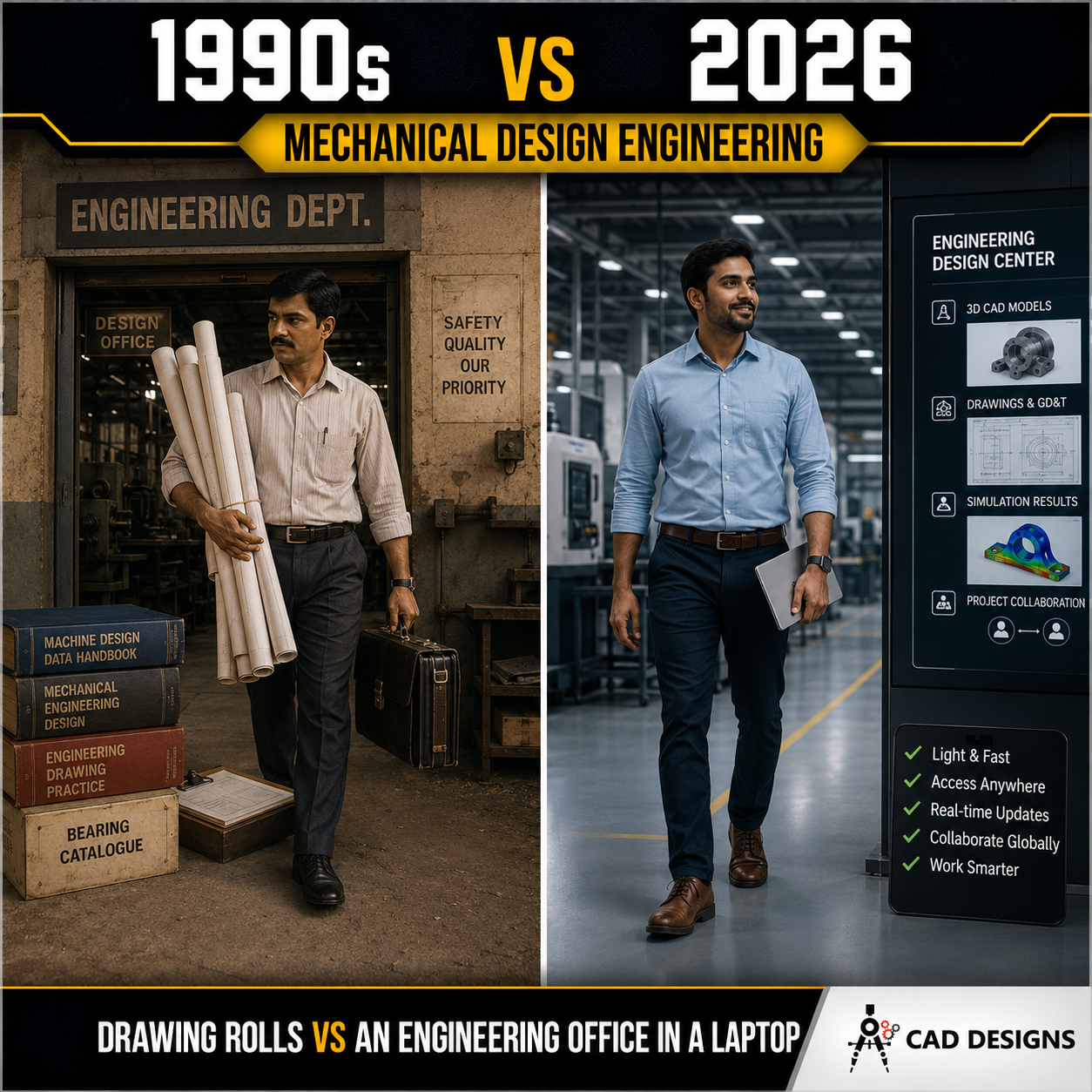
14. Drawing Rolls and Briefcases vs Laptop and Tablet
An engineer travelling to a supplier or manufacturing facility once might have carried:
Drawing rolls.
Printed specifications.
Notebooks.
Component catalogues.
Calculation sheets.
Today, much of that engineering office can fit inside a laptop or tablet.
Thousands of drawings and documents can travel with an engineer without filling a single drawing cabinet.
From an office full of paper to an office inside a backpack.
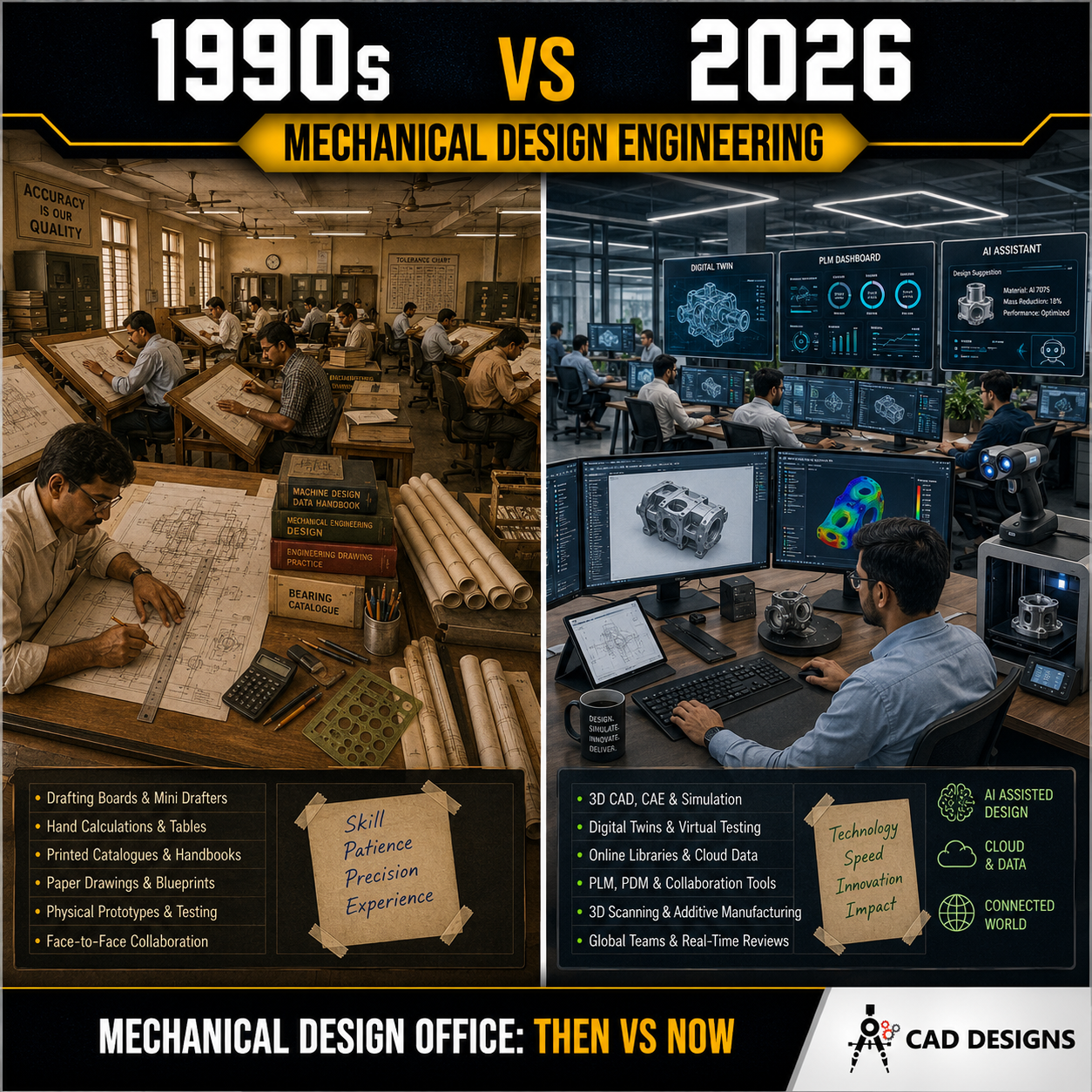
15. Mechanical Design Office: 1990s vs 2026
Perhaps this comparison captures the entire transformation.
A Mechanical Design Office in the 1990s
Rows of drafting boards.
Large drawings.
Pencils and erasers.
Engineering handbooks.
Printed catalogues.
Calculators.
Physical prototypes.
Drawing cabinets.
A Mechanical Design Office in 2026
High-performance workstations.
Multiple monitors.
3D CAD.
CAE simulation.
PLM/PDM.
Cloud collaboration.
3D scanning.
Additive manufacturing.
AI-assisted engineering tools.
The environment looks completely different.
But underneath all that technology is something that hasn’t changed:
The Engineering Mindset
A computer doesn’t replace the need to understand:
- Loads and boundary conditions
- Materials
- Manufacturing processes
- Fits and tolerances
- GD&T
- Failure modes
- Cost
- Reliability
- Safety
- Assembly
- Serviceability
- Design intent
The engineer of the 1990s and the engineer of 2026 may use completely different tools.
But both are trying to answer the same fundamental question:
“How can I design this better?”
What Did We Gain—and What Should We Never Lose?
Modern engineering tools have given designers extraordinary capabilities.
Tasks that once required days can sometimes be completed in hours. Designs can be visualized before manufacturing. Teams can collaborate globally. Simulation can reveal potential problems before expensive prototypes are produced.
But there is also something worth remembering from the earlier engineering era.
Engineers often developed strong fundamentals because they couldn’t depend on software for every answer.
A beautiful simulation result is meaningless when the boundary conditions are wrong.
A perfect 3D model is useless when the component cannot be manufactured economically.
And an automatically generated drawing is dangerous when nobody understands the tolerances.
Technology should amplify engineering knowledge—not replace it.
1990s → 2026: Same Engineering, Better Tools
From drafting boards to digital twins.
From pencils to parametric CAD.
From physical catalogues to online libraries.
From hand calculations to simulation.
From drawing cabinets to PLM.
From prototypes to additive manufacturing.
From local drawing-table discussions to global digital collaboration.
Mechanical Design Engineering has experienced an incredible transformation.
And we are probably only at the beginning of the next one.
With AI-assisted design, generative engineering, advanced simulation, digital twins, additive manufacturing and increasingly intelligent engineering software, the mechanical design office of 2040 may look just as different from 2026 as today’s office looks from the 1990s.
A Question for Experienced Engineers
Which old-school mechanical design tool or engineering practice do you remember most?
Was it the drafting board? Mini-drafter? Engineering calculator? Huge bearing catalogues? Drawing rolls? Blueprints? Or endless manual calculations?
Share your memories with the next generation of engineers.
Because understanding where engineering came from helps us appreciate where it is going.