15 Amazing Engineering Designs Inspired by Nature – How Nature Solved Engineering Problems First
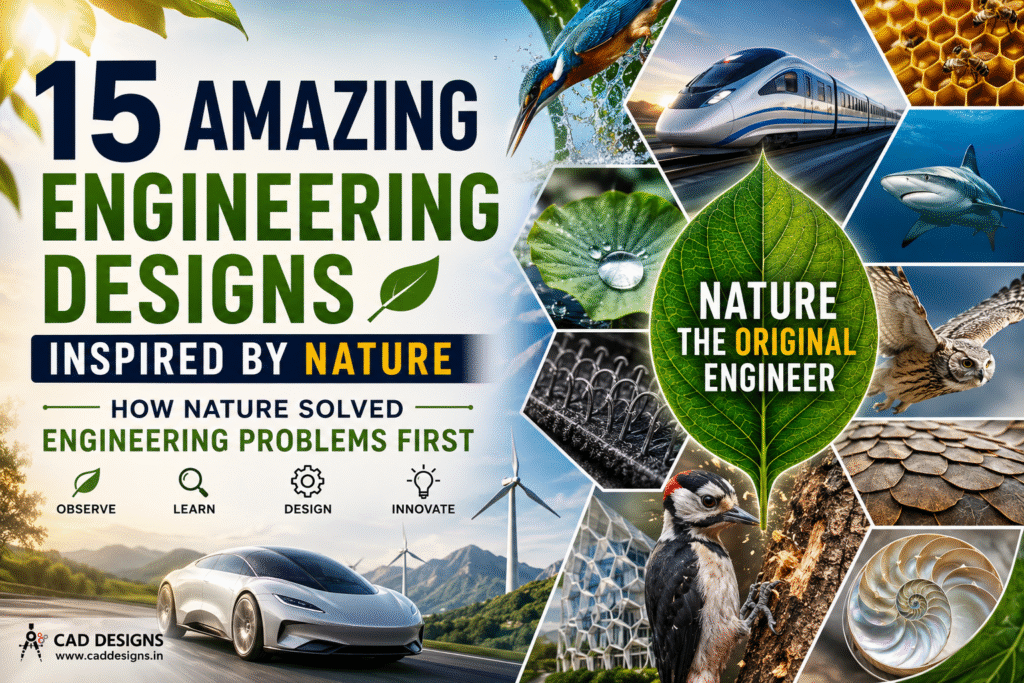
Nature has been solving complex engineering problems for millions of years.
Before engineers designed aircraft, high-speed trains, advanced adhesives, cooling systems, lightweight structures, and water-resistant surfaces, nature had already developed highly efficient solutions through evolution.
The engineering approach of studying nature and applying its principles to human-made products is commonly known as biomimicry or bio-inspired design.
For engineers, biomimicry is much more than simply copying the shape of an animal or plant. The important question is:
What engineering principle makes the natural system work, and how can we apply that principle to a practical design?
Here are 15 fascinating examples of engineering inspired by nature.
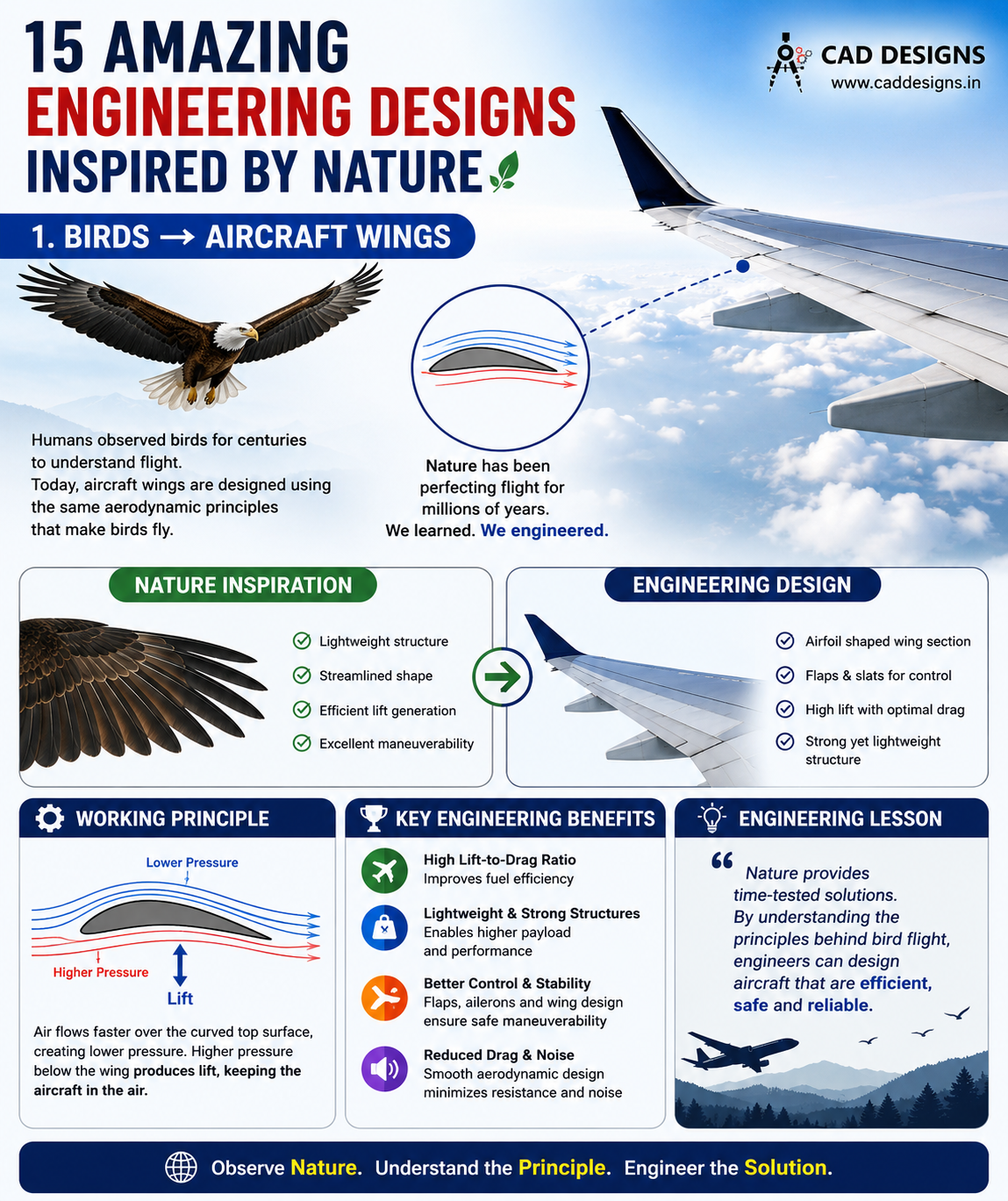
1. Birds → Aircraft Wings ✈️
One of the most recognizable examples of bio-inspired engineering is human flight.
For centuries, humans observed how birds generate lift, glide, change direction, and control their flight. Early aviation pioneers studied bird wings carefully while developing flying machines.
Modern aircraft do not simply copy bird wings, but many fundamental ideas of flight are closely connected to observations of natural flight.
Engineering Principle
An aircraft wing creates a pressure distribution around its aerodynamic profile. Combined with the downward deflection of airflow, this produces lift.
Engineers optimize:
Wing shape
Airfoil profile
Angle of attack
Aspect ratio
Wing loading
Flaps and control surfaces
Engineering Lesson
Nature does not necessarily give engineers the final design—it often reveals the physical principle behind the solution.
1. Birds → Aircraft Wings
2. Kingfisher Beak → High-Speed Train Nose 🚄
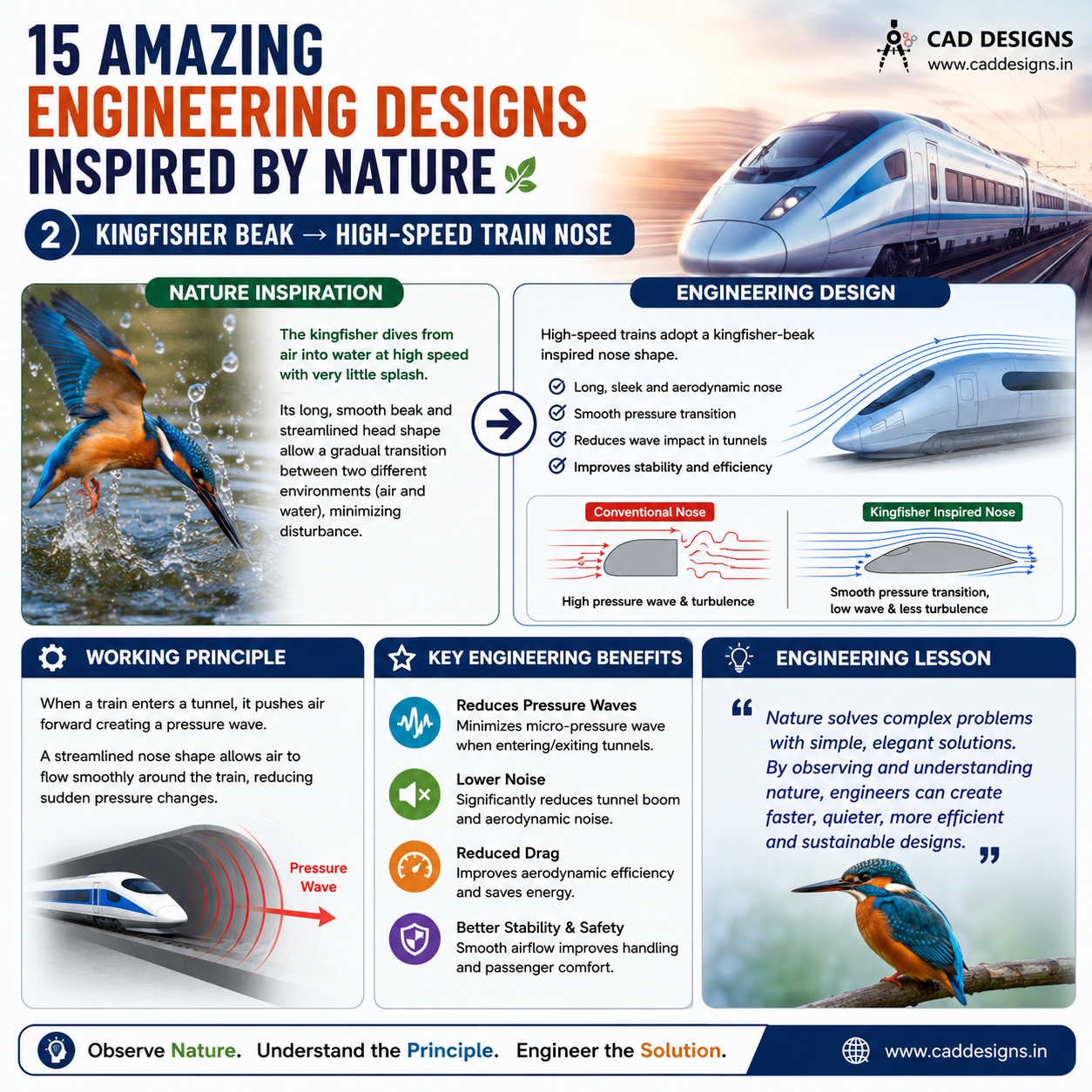
High-speed trains face an interesting aerodynamic problem when entering tunnels.
A train moving rapidly into a tunnel creates a pressure wave. This can result in aerodynamic noise and pressure disturbances, particularly near the tunnel exit.
The streamlined beak of a kingfisher provided inspiration for improving high-speed train nose design.
A kingfisher can move rapidly from air into water while creating relatively little splash because of the streamlined geometry of its beak and head.
Engineering Principle
A gradually changing aerodynamic profile helps manage pressure changes more smoothly.
Engineering Benefits
An optimized train nose can contribute to:
Reduced pressure waves
Lower aerodynamic noise
Reduced aerodynamic drag
Improved high-speed efficiency
Engineering Lesson
Sometimes solving an engineering problem requires looking at how nature handles a similar transition between two environments.
2. Kingfisher Beak → High-Speed Train Nose
3. Gecko Feet → Dry Adhesives and Climbing Robots 🦎
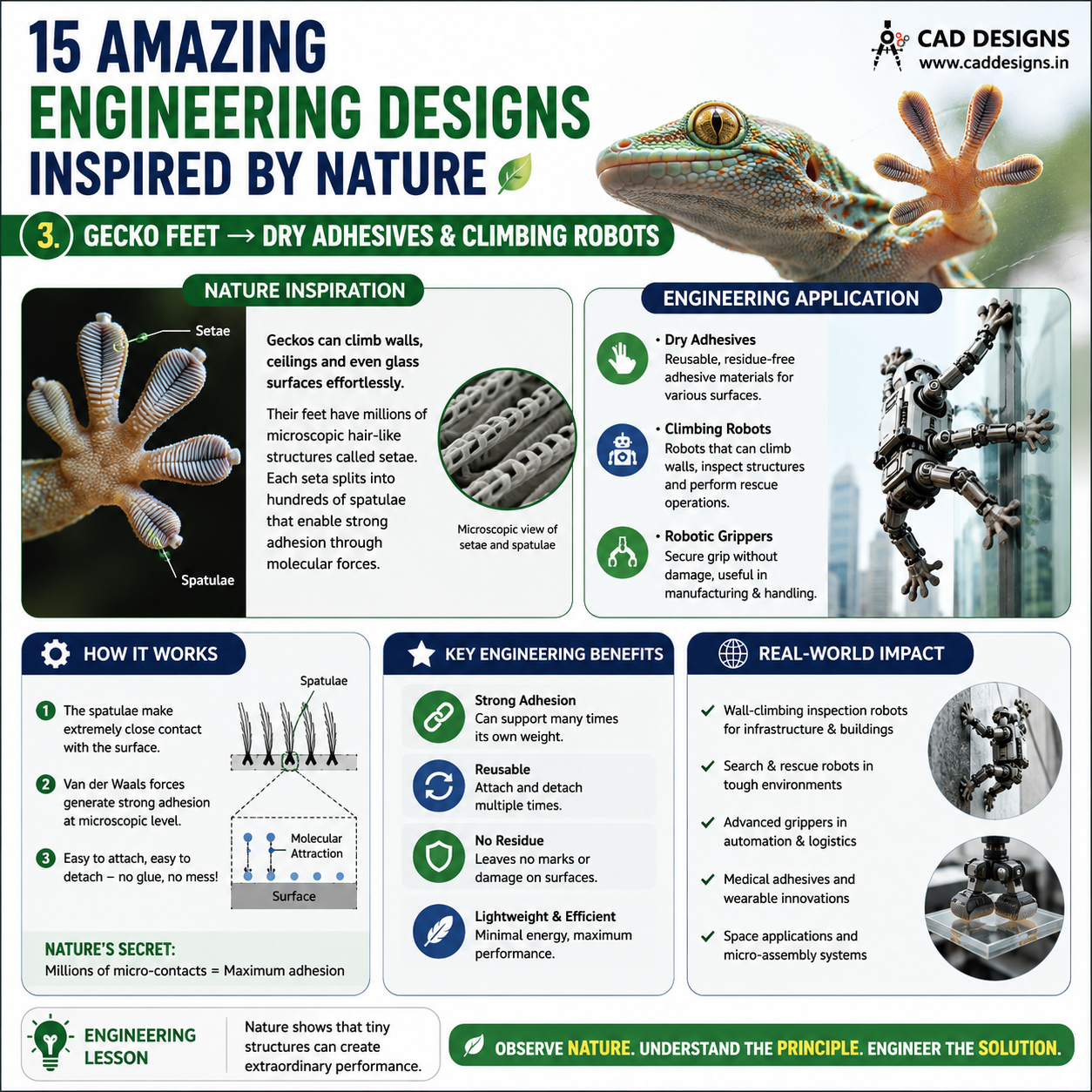
Geckos can climb walls and even move across ceilings without conventional glue.
Their feet contain millions of microscopic hair-like structures called setae, which divide into even smaller structures.
These structures allow extremely close contact with surfaces, enabling intermolecular attractive forces to generate significant adhesion.
Engineers have studied this mechanism to develop:
Dry adhesives
Reusable adhesive materials
Wall-climbing robots
Robotic grippers
Engineering Lesson
A material does not always need to change chemically to gain a new function. Sometimes changing its surface structure is enough.
3. Gecko Feet → Dry Adhesives and Climbing Robots
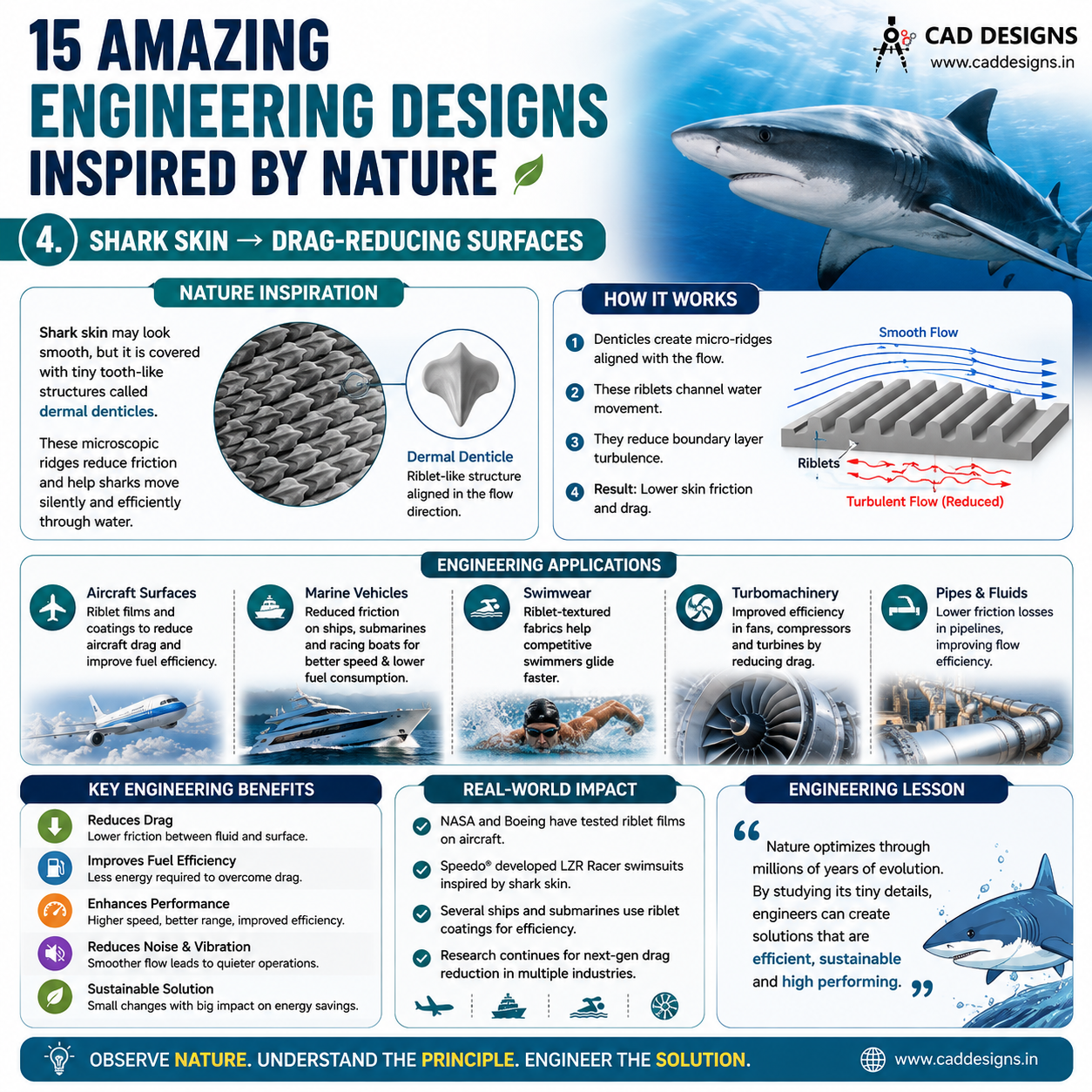
4. Shark Skin → Drag-Reducing Surfaces 🦈
Shark skin may look smooth from a distance, but microscopically it contains small tooth-like structures called dermal denticles.
Their geometry influences the interaction between the shark’s body and surrounding water.
Engineers have investigated shark-skin-inspired riblet surfaces for applications where controlling fluid friction is important.
Potential applications include:
Aircraft surfaces
Marine vehicles
Pipes
Competitive swimwear
Turbomachinery
Engineering Principle
Surface texture can influence boundary-layer flow and skin-friction drag.
Engineering Lesson
A perfectly smooth surface is not automatically the most aerodynamically or hydrodynamically efficient surface.
4. Shark Skin → Drag-Reducing Surfaces
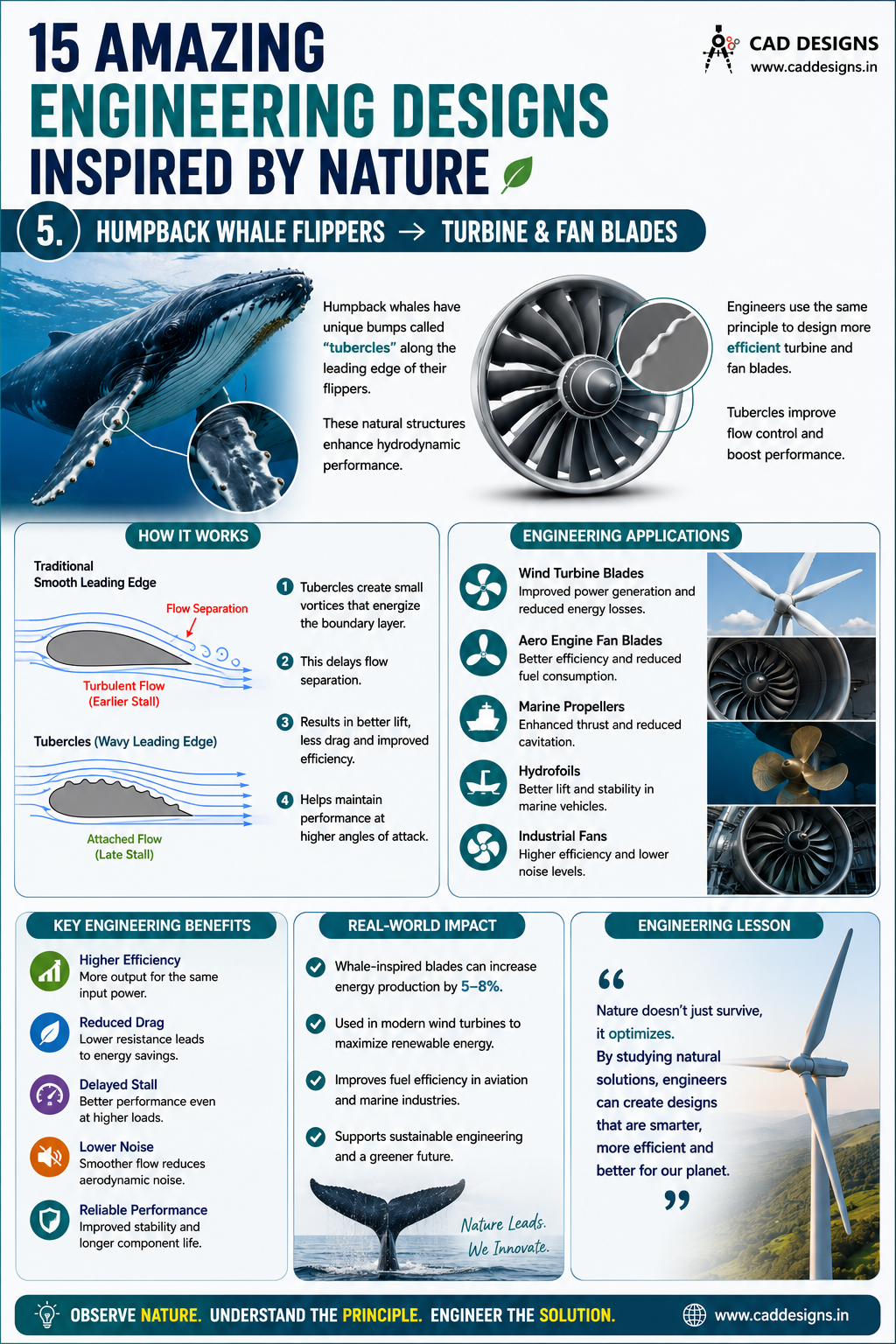
5. Humpback Whale Flippers → Turbine and Fan Blades 🐋
Humpback whales have unusual bumps called tubercles along the leading edges of their flippers.
At first glance, these irregularities may appear aerodynamically inefficient.
However, research into tubercle-inspired profiles has shown that these geometries can influence flow separation and stall characteristics.
Engineers have explored similar concepts for:
Wind turbine blades
Fans
Propellers
Hydrofoils
Other fluid-dynamic components
Engineering Lesson
The most efficient engineering geometry is not always perfectly straight or smooth.
5. Humpback Whale Flippers → Turbine and Fan Blades
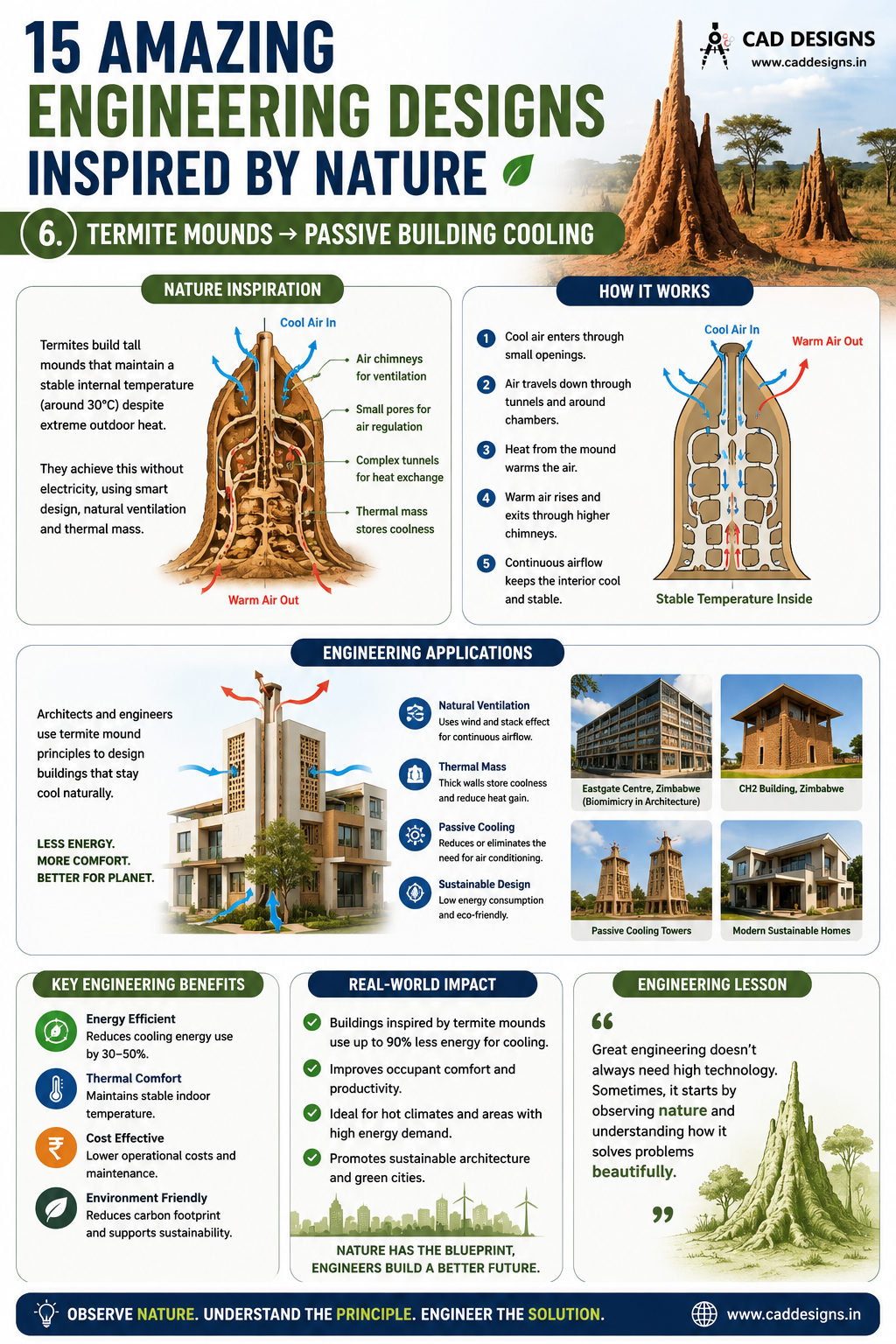
6. Termite Mounds → Passive Building Cooling 🐜
Termite colonies can maintain surprisingly stable internal environmental conditions even when outside temperatures fluctuate significantly.
Their mound structures use combinations of airflow paths, thermal mass, porosity, and natural convection.
Architects and engineers have studied these principles for passive building ventilation.
Engineering Applications
Bio-inspired buildings can potentially reduce dependence on:
Air conditioning
Mechanical ventilation
High-energy cooling systems
Engineering Lesson
Before adding more cooling equipment, engineers should first ask whether geometry and natural airflow can solve part of the problem.
6. Termite Mounds → Passive Building Cooling
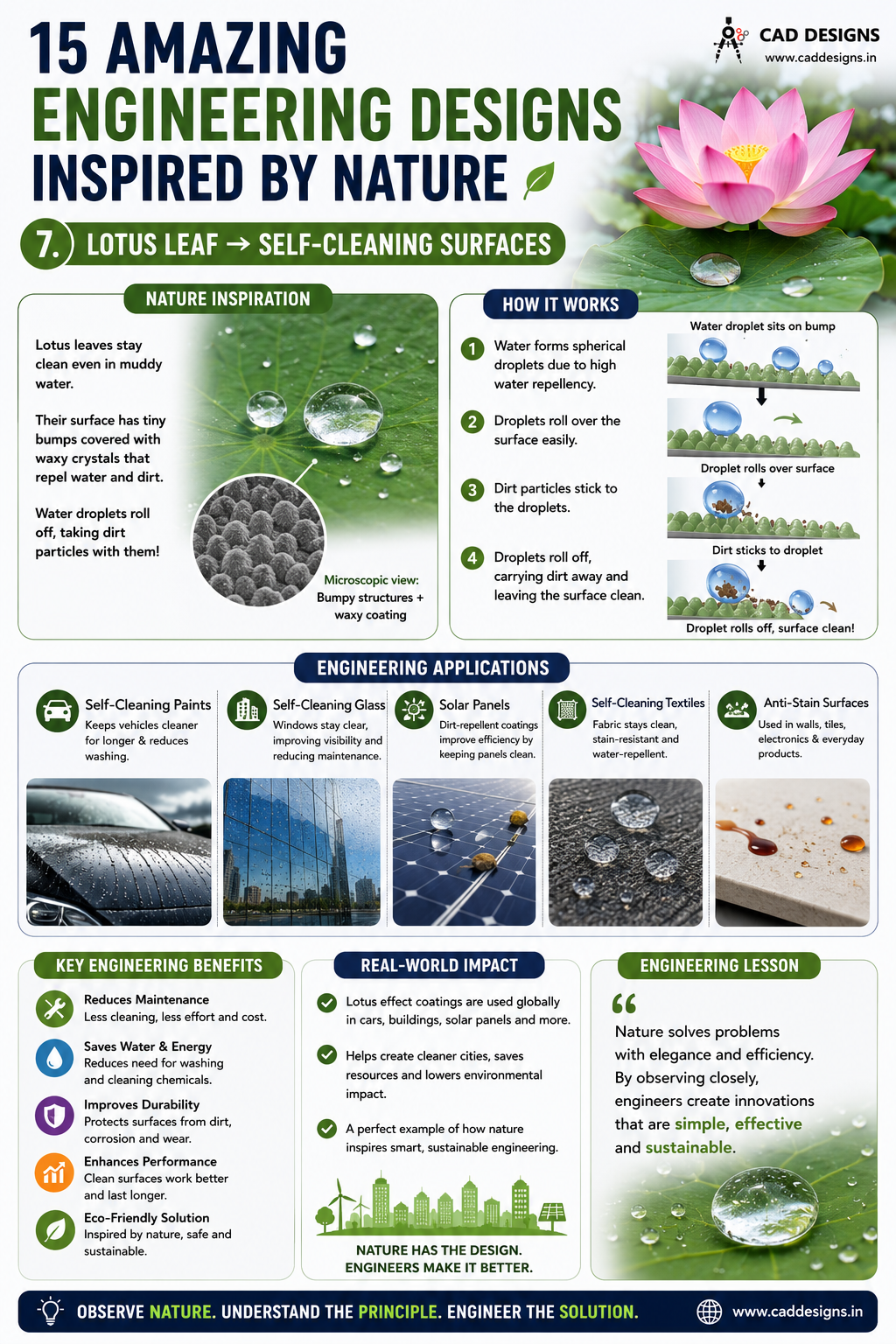
7. Lotus Leaf → Self-Cleaning Surfaces 🪷
Lotus leaves remain remarkably clean despite growing in muddy environments.
Their surfaces contain microscopic and nanoscale structures combined with water-repellent chemistry.
Water forms droplets rather than spreading across the surface. As these droplets roll away, they can collect dirt particles.
This behavior is known as the lotus effect.
Engineering Applications
The principle has inspired:
Self-cleaning glass
Water-resistant coatings
Exterior paints
Textiles
Anti-fouling surfaces
Engineering Lesson
Surface engineering can sometimes provide functionality that would otherwise require additional mechanisms or maintenance.
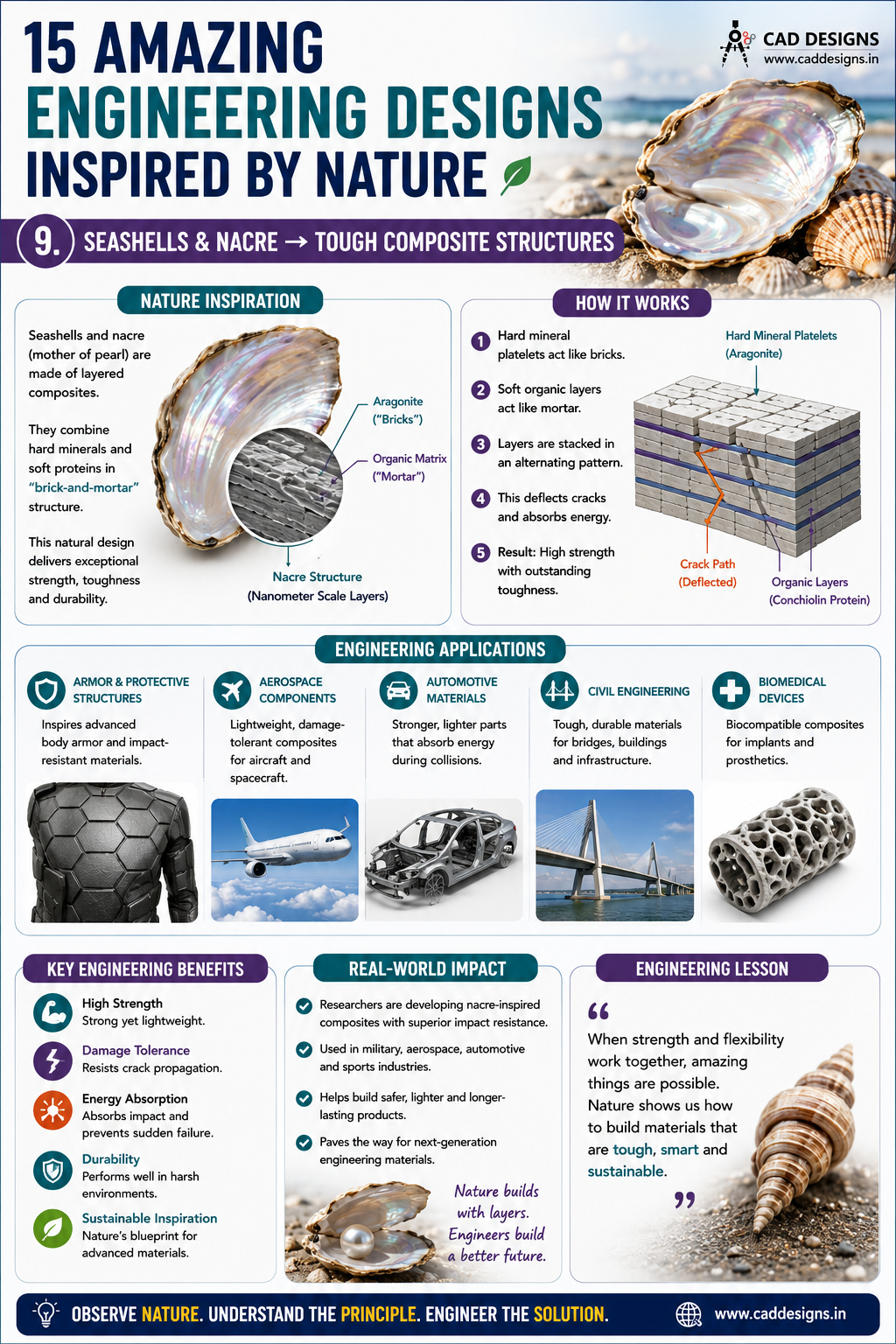
9. Seashells and Nacre → Tough Composite Structures 🐚
Seashells provide another excellent lesson in structural design.
Nacre, commonly called mother-of-pearl, consists of hard mineral platelets arranged within a softer organic matrix.
This hierarchical structure helps prevent cracks from propagating easily.
Instead of allowing a crack to travel through the material along a simple path, the layered architecture can deflect and resist crack growth.
Engineering Applications
This concept inspires research into:
Impact-resistant composites
Protective structures
Lightweight panels
Ceramic composites
Armor systems
Engineering Lesson
Preventing crack propagation can be as important as increasing the strength of the material itself.
9. Seashells and Nacre → Tough Composite Structures
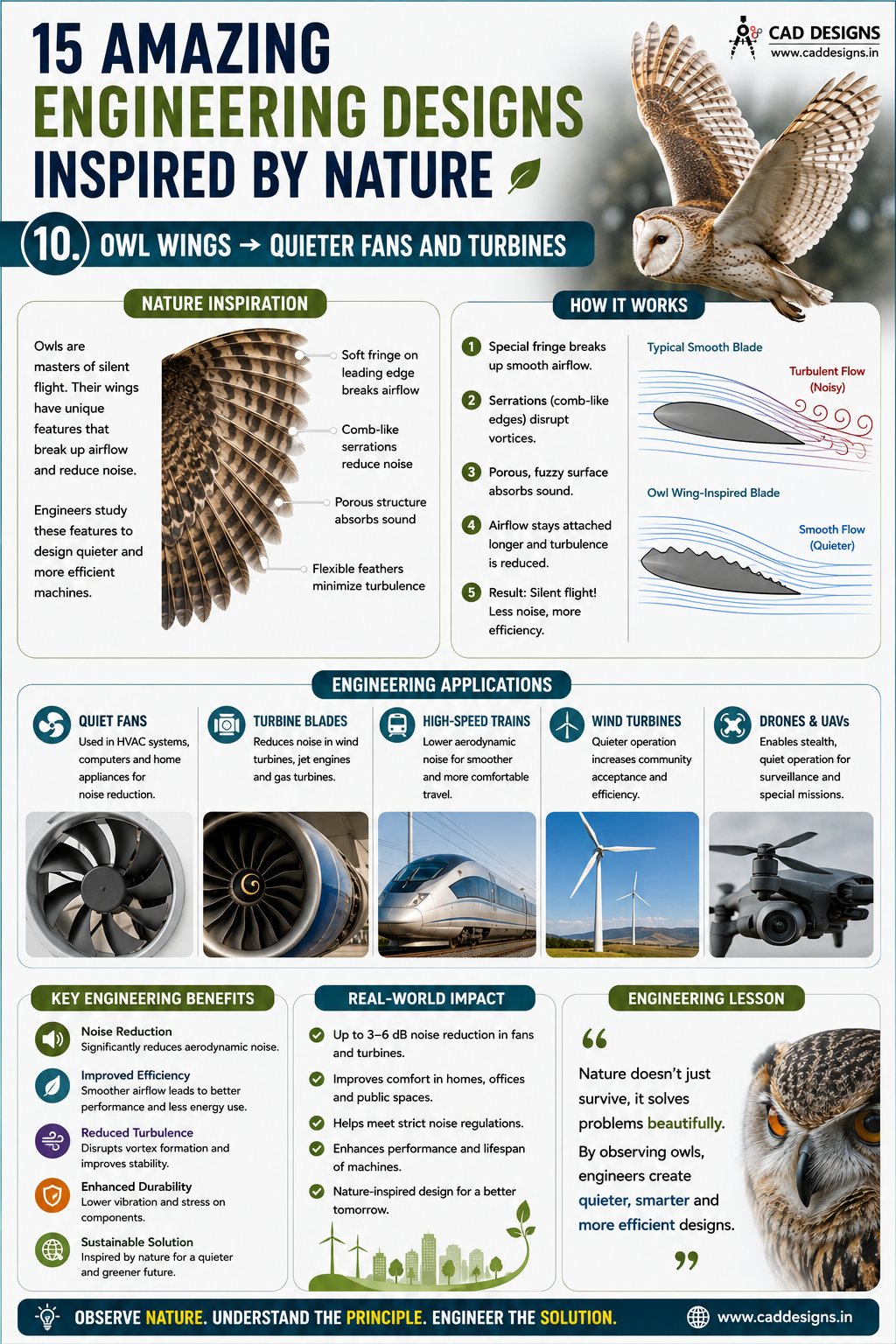
10. Owl Wings → Quieter Fans and Turbines 🦉
Owls are famous for their remarkably quiet flight.
Their feathers contain specialized features, including serrated leading-edge structures and soft trailing-edge characteristics, that influence airflow and aerodynamic noise.
Engineers study these mechanisms when developing quieter:
Wind turbine blades
Cooling fans
Propellers
Aircraft components
Industrial ventilation systems
Engineering Lesson
Noise is often a fluid-flow problem as much as an acoustic problem.
10. Owl Wings → Quieter Fans and Turbines
Five More Fascinating Nature-Inspired Engineering Designs
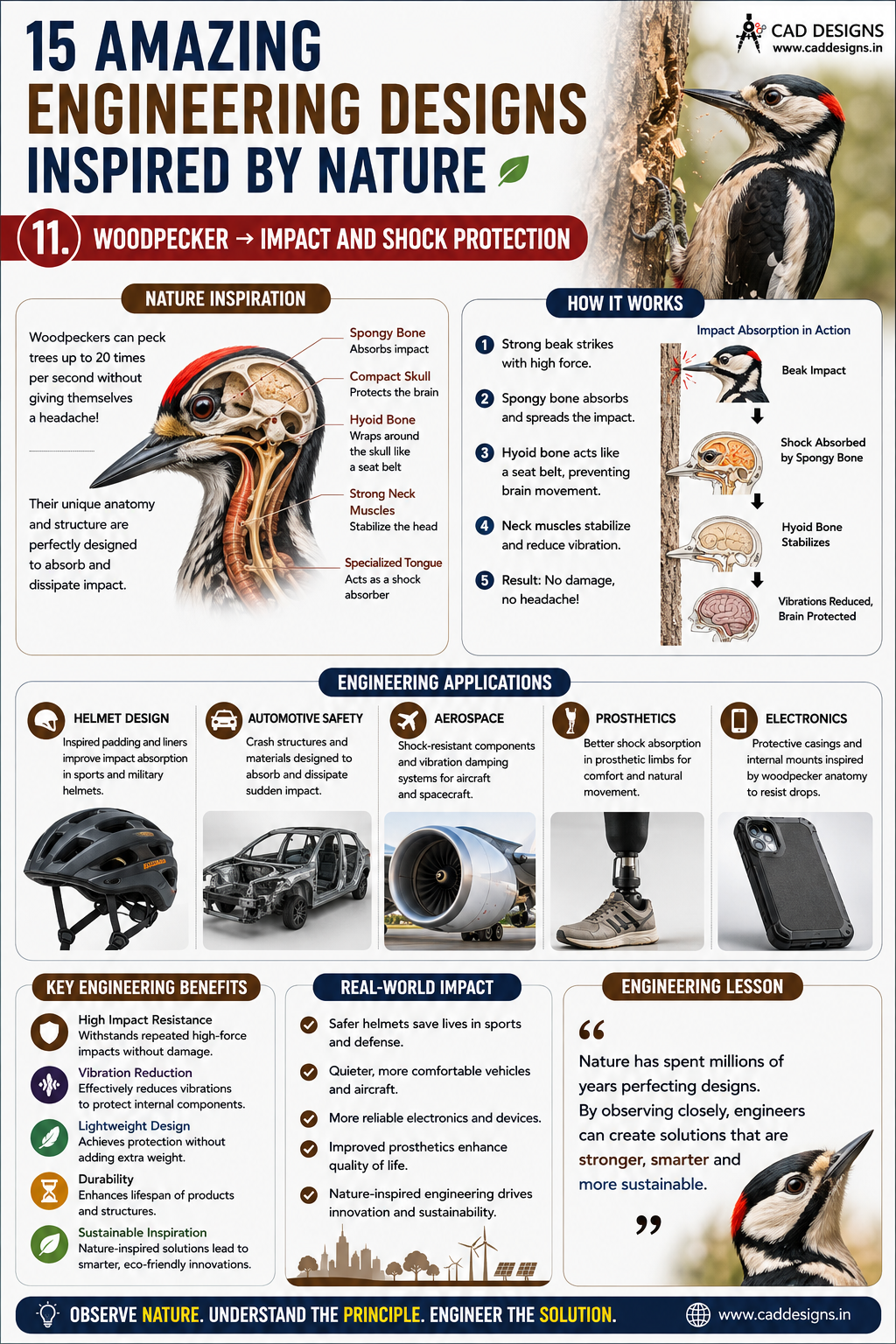
11. Woodpecker → Impact and Shock Protection 🐦
A woodpecker repeatedly strikes wood at high speed while performing feeding and nesting behaviors.
Its anatomy has therefore attracted considerable attention from researchers studying impact management.
Rather than interpreting the bird as having one simple “shock absorber,” engineers study how its skull geometry, beak, tissues, and overall biological structure interact under repeated impacts.
Engineering Inspiration
These studies can contribute to concepts involving:
Impact protection
Protective structures
Vibration management
Shock-resistant packaging
Helmet research
Engineering Lesson
Impact protection is often a system-level problem rather than something solved by a single material.
11. Woodpecker → Impact and Shock Protection
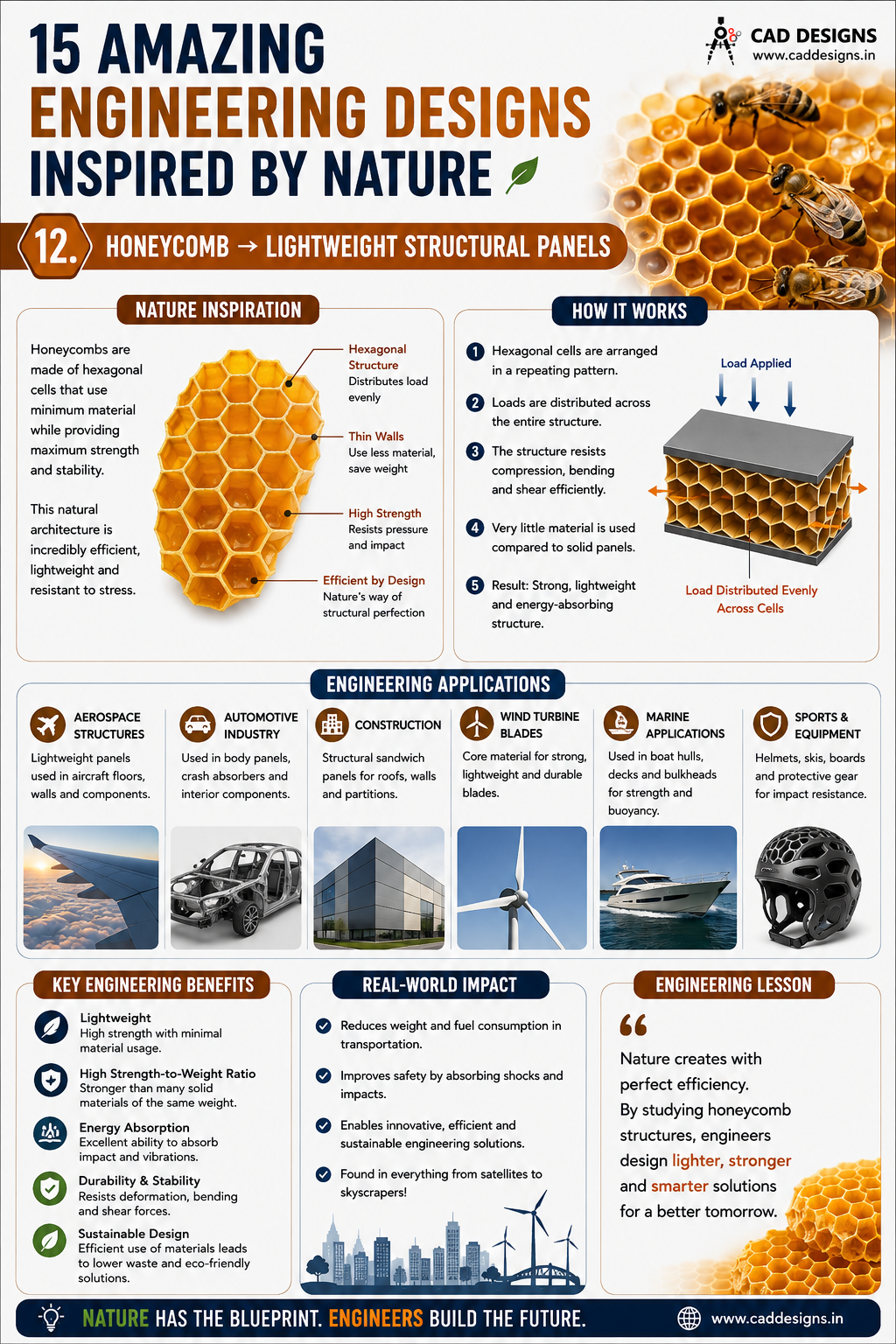
12. Honeycomb → Lightweight Structural Panels 🍯
Bees construct honeycombs using repeating hexagonal cells.
The honeycomb concept has become extremely important in modern lightweight engineering.
Honeycomb-core sandwich structures can provide high bending stiffness while keeping overall mass relatively low.
They are widely used in areas such as:
Aerospace structures
Aircraft interiors
Automotive components
Marine structures
Composite panels
Engineering Principle
Instead of filling an entire component with solid material, engineers strategically distribute material where it contributes most effectively to structural performance.
Engineering Lesson
Material placement is often more important than simply adding more material.
12. Honeycomb → Lightweight Structural Panels
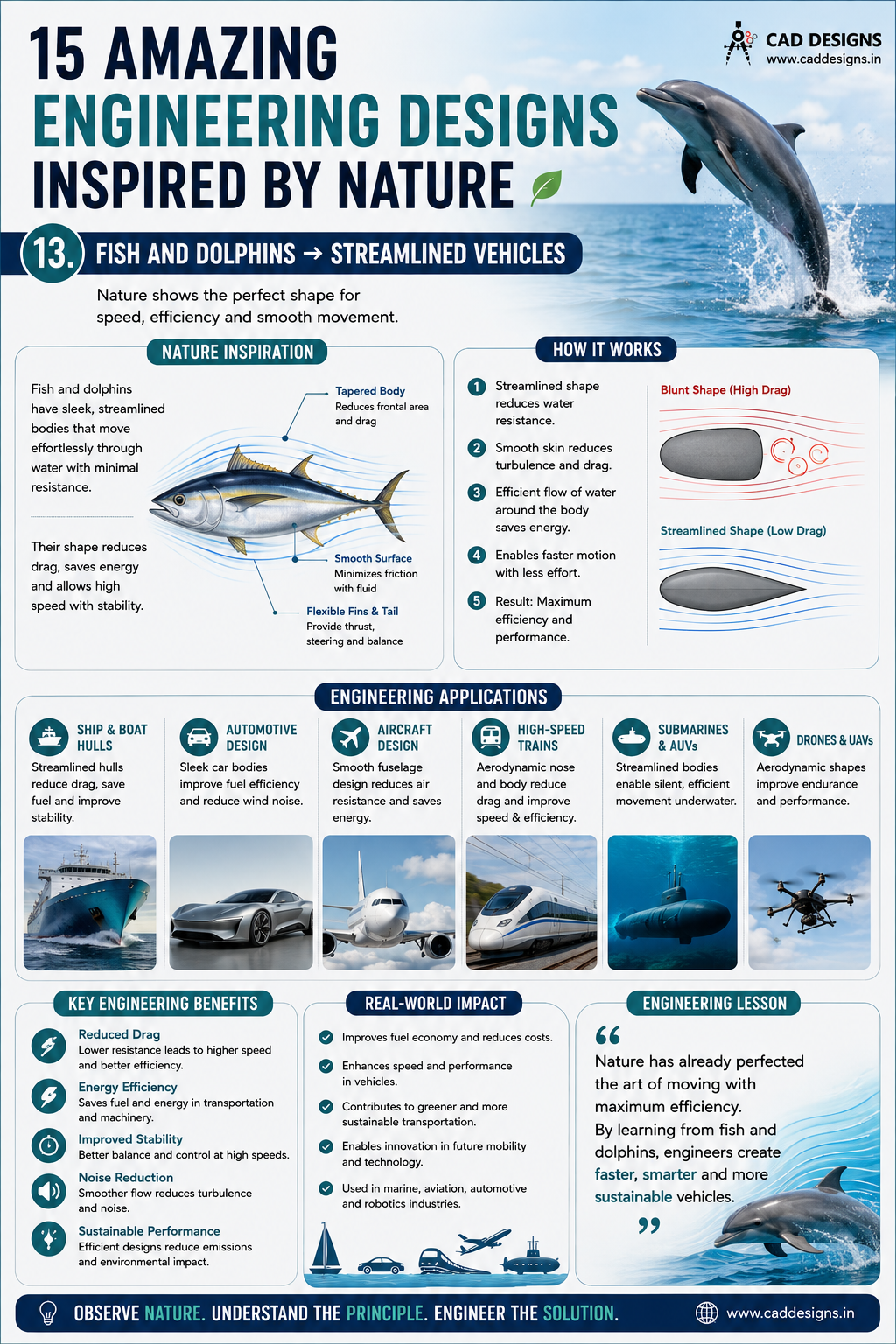
13. Fish and Dolphins → Streamlined Vehicles 🐬
Fish, dolphins, and many other aquatic animals have evolved streamlined body shapes that allow efficient movement through water.
Their bodies minimize unnecessary flow separation and reduce resistance while maintaining maneuverability.
Engineers apply similar principles when designing:
Submarines
Torpedoes
Underwater robots
Autonomous underwater vehicles
Marine structures
Engineering Lesson
When a component moves through a fluid, external geometry becomes part of the energy-efficiency problem.
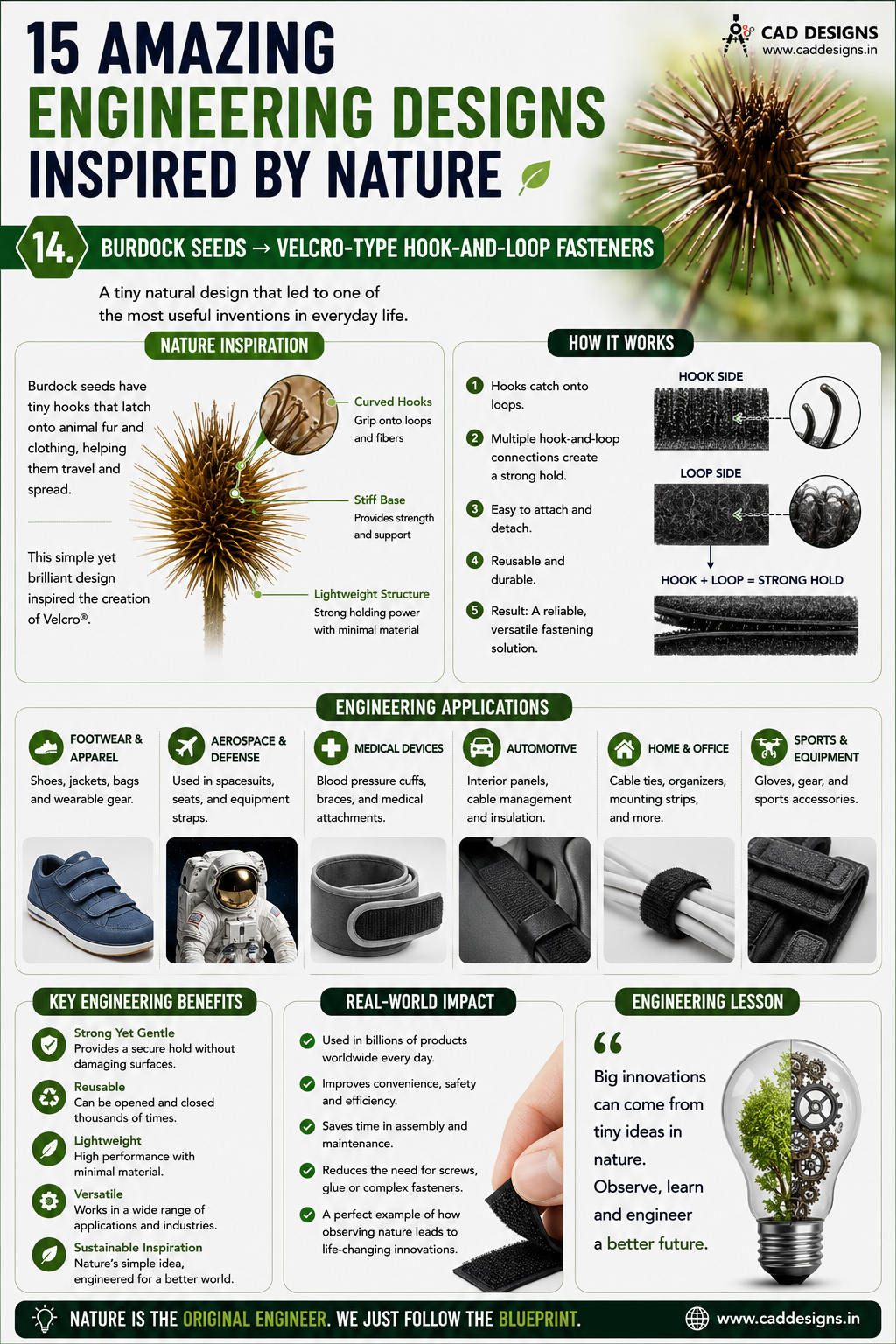
This is one of the most famous examples of biomimicry.
Burdock burrs can attach themselves to animal fur and clothing using tiny hook-like structures.
After observing this natural attachment mechanism, engineer George de Mestral investigated the burrs and developed the concept that eventually became hook-and-loop fastening technology.
Engineering Principle
Instead of relying on permanent bonding, two complementary surface structures can create repeated mechanical attachment.
Engineering Lesson
Small everyday observations can lead to major engineering innovations when engineers ask why something behaves the way it does.
This way of thinking is much more valuable than simply copying nature’s appearance.
Why Biomimicry Matters for Modern Engineers
Modern engineering problems increasingly demand designs that are:
Lightweight
Energy efficient
Strong
Durable
Quiet
Sustainable
Material efficient
Multifunctional
Nature frequently solves several of these requirements simultaneously.
A tree, for example, must carry loads while using limited material. A bird wing must generate lift while remaining lightweight. A seashell must protect a living organism without becoming excessively heavy. A lotus leaf must remain functional despite continuous exposure to water and contamination.
These are essentially engineering optimization problems.
Nature therefore provides engineers with something extremely valuable:
Millions of examples of designs that have already undergone extensive evolutionary optimization.
Final Thought
The next major engineering innovation may not begin with a CAD model, simulation, or equation.
It may begin by observing a bird, shark, whale, insect, leaf, shell, or microscopic biological structure and asking:
“Why did nature design it this way?”
That question can transform observation into an engineering problem—and an engineering problem into innovation.
Nature is not only beautiful. It is one of the world’s oldest engineering laboratories.