
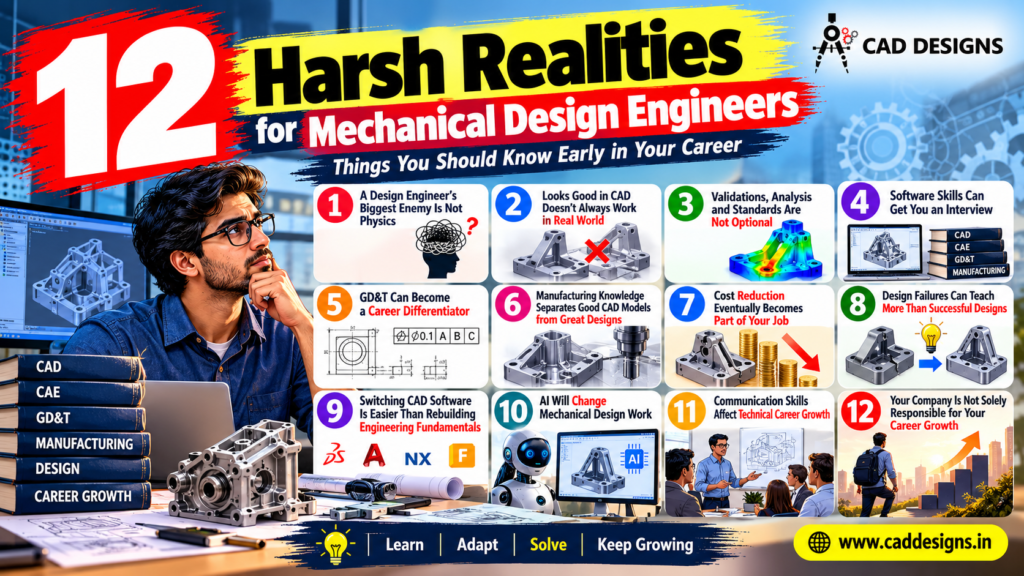
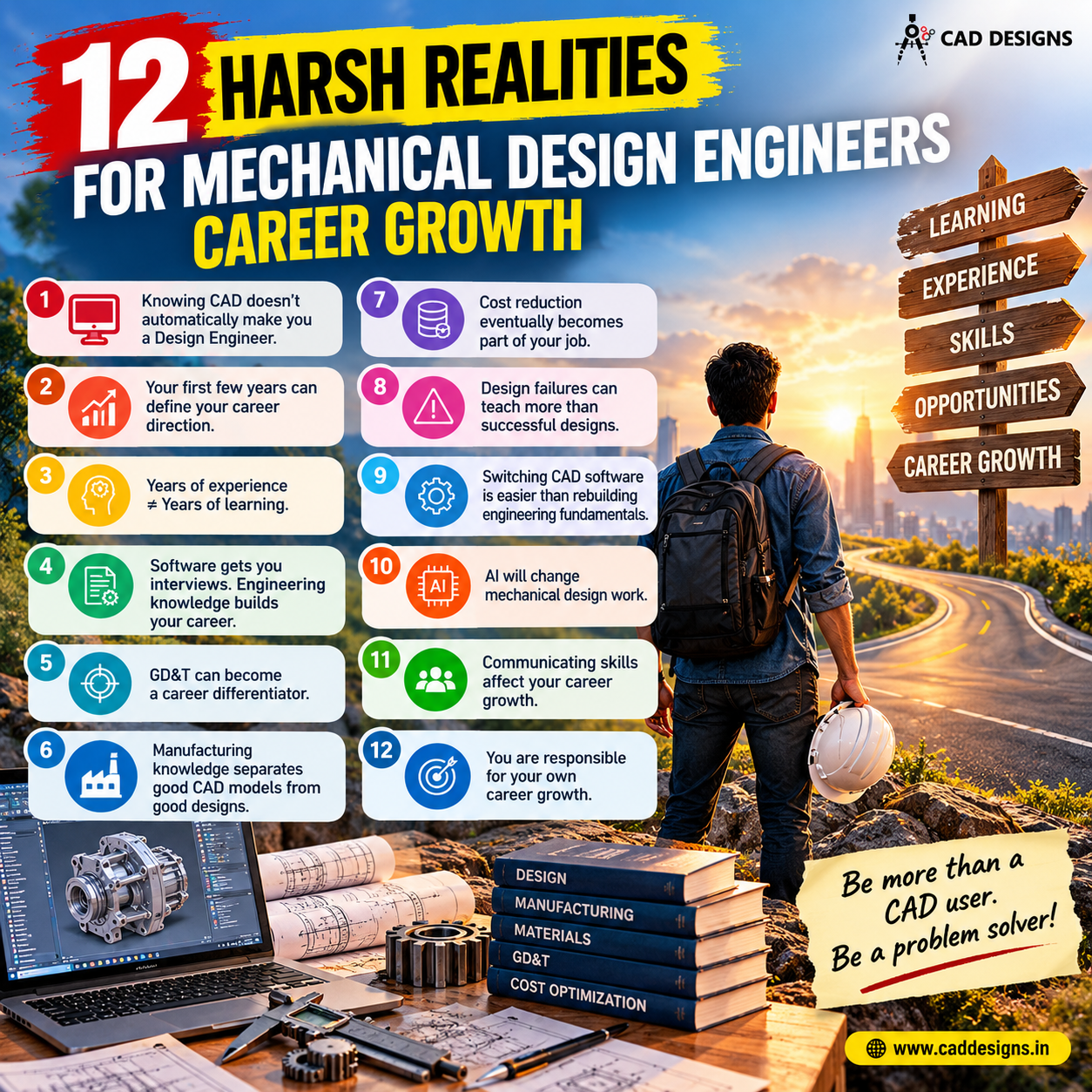

12 Harsh Realities of Mechanical Design Engineering Career Growth

12 Harsh Realities for Mechanical Design Engineers

12 Harsh Realities of Mechanical Design Engineering Career Growth

CAD skills can open the door—but they do not guarantee career growth. Mechanical Design Engineering rewards engineers who combine software skills with engineering judgment, manufacturing knowledge, cost awareness, validation, communication, and continuous learning.

If you are a student, fresher, or working design engineer, these 12 realities can help you make better career decisions before years pass by.

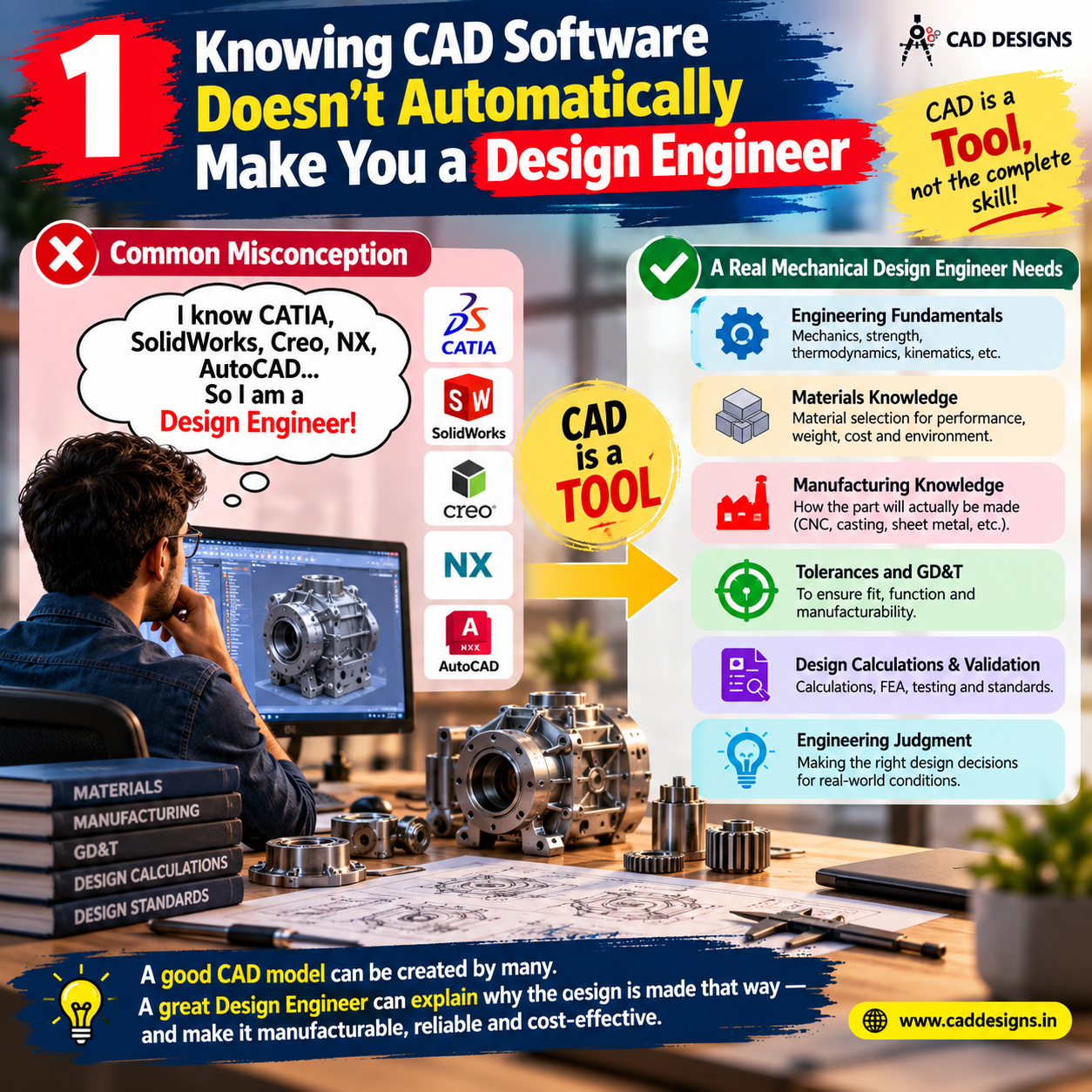
1. Knowing CAD Software Doesn’t Automatically Make You a Design Engineer

Knowing CATIA, SolidWorks, Creo, NX, or AutoCAD is valuable—but CAD is ultimately a tool.

A professional Mechanical Design Engineer must understand engineering fundamentals, design decisions, manufacturing, materials, tolerances, validation, and CAD together. Creating a beautiful 3D model is relatively easy; knowing why a wall thickness should be 3 mm instead of 5 mm requires engineering judgment.

Career Lesson: Don’t become only a CAD operator. Become an engineer who can explain the engineering reasoning behind every important design decision.

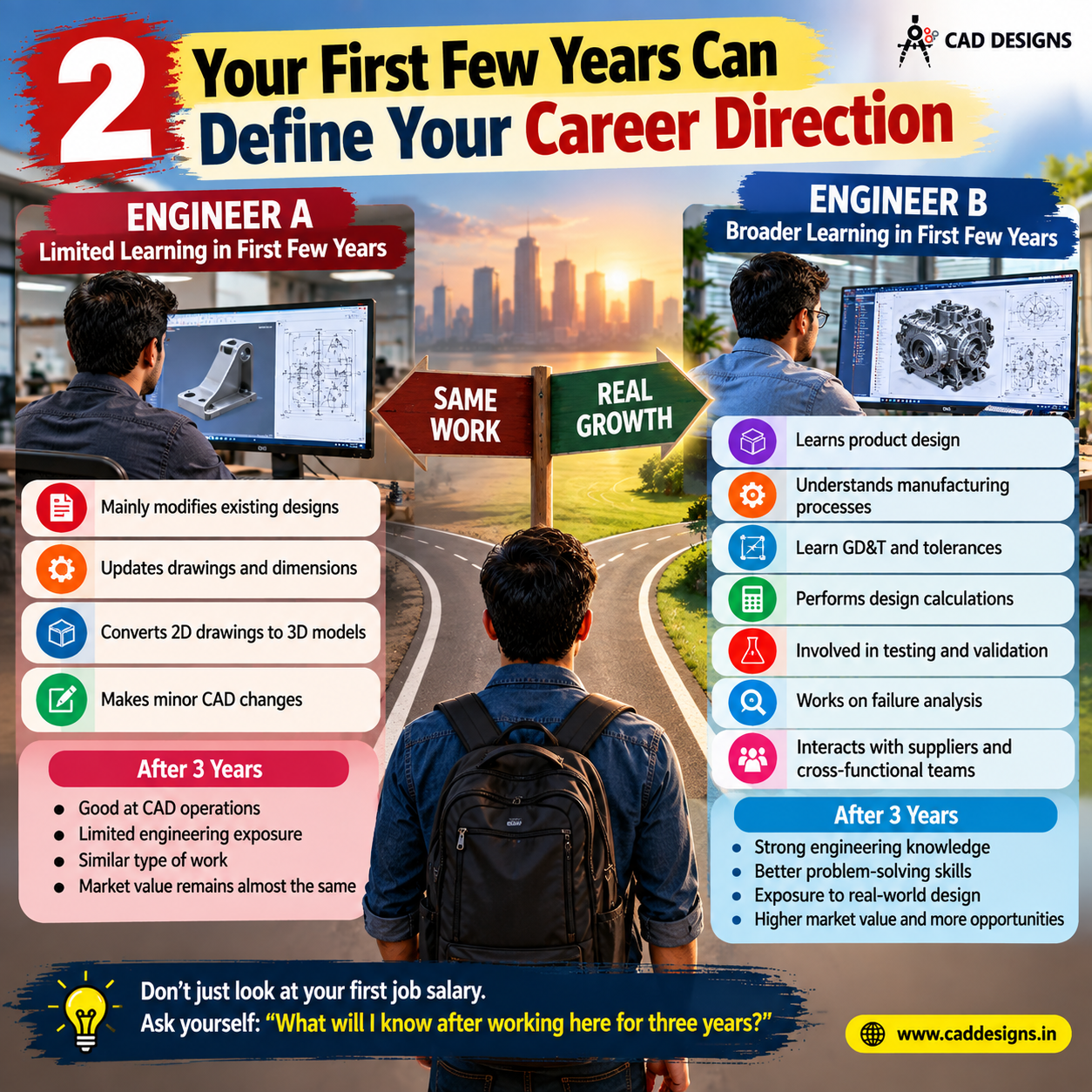
2. Your First Few Years Can Define Your Career Direction

Your first job matters more than many graduates realize.

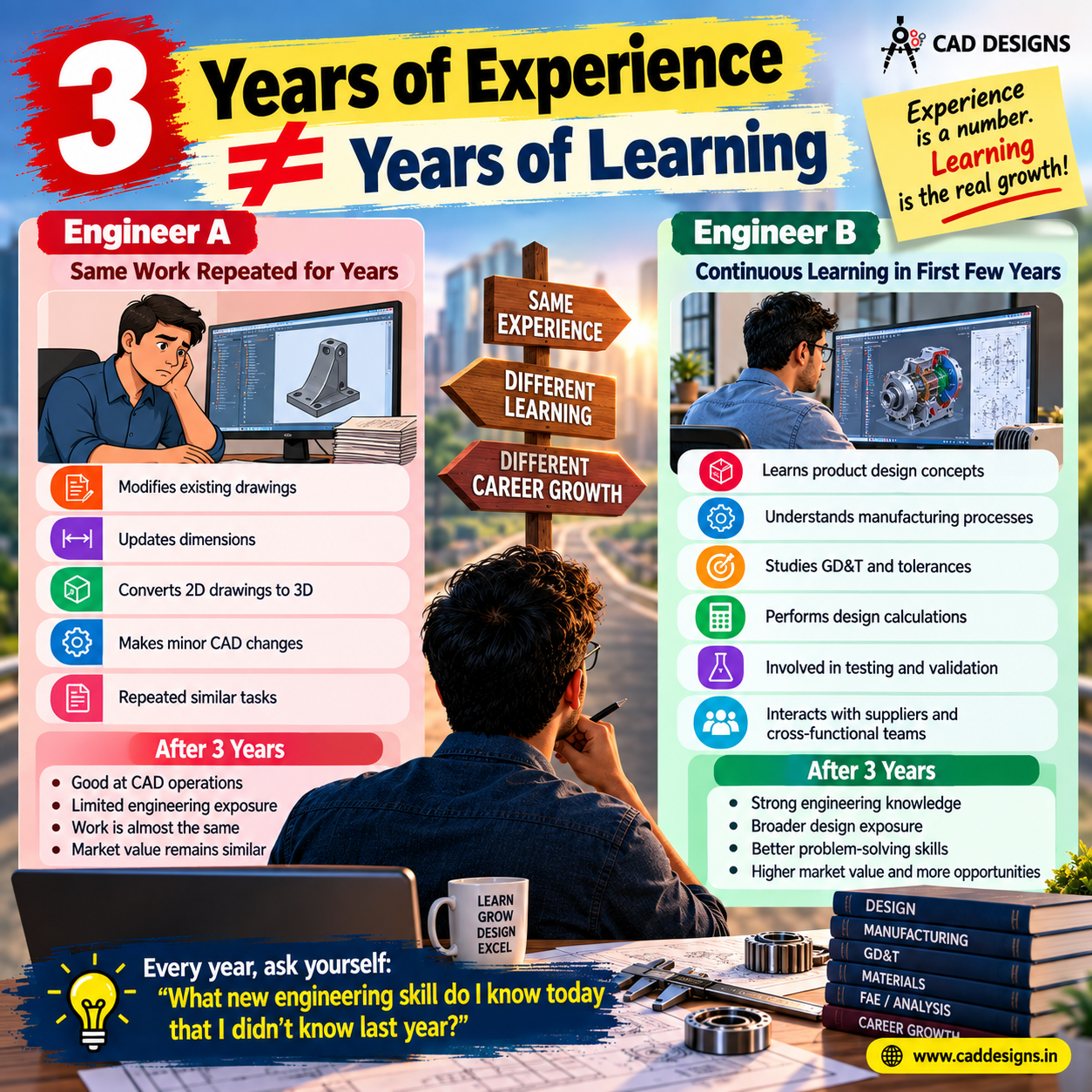
Two engineers may both have three years of experience, but one may have spent those years mostly updating drawings while the other learned product design, tolerance analysis, manufacturing, GD&T, design calculations, testing, failure analysis, and supplier interaction.

Career Lesson: Don’t evaluate a job only by salary. Ask yourself: What will I know after working here for three years?

3. Years of Experience ≠ Years of Learning

Having 10 years of experience does not automatically mean ten years of engineering growth. Sometimes it becomes one year of learning repeated ten times.

If your work remains almost identical for years, your experience number may increase while your market value stays nearly unchanged.

Career Lesson: Every year ask: What engineering skill do I know today that I didn’t know last year?

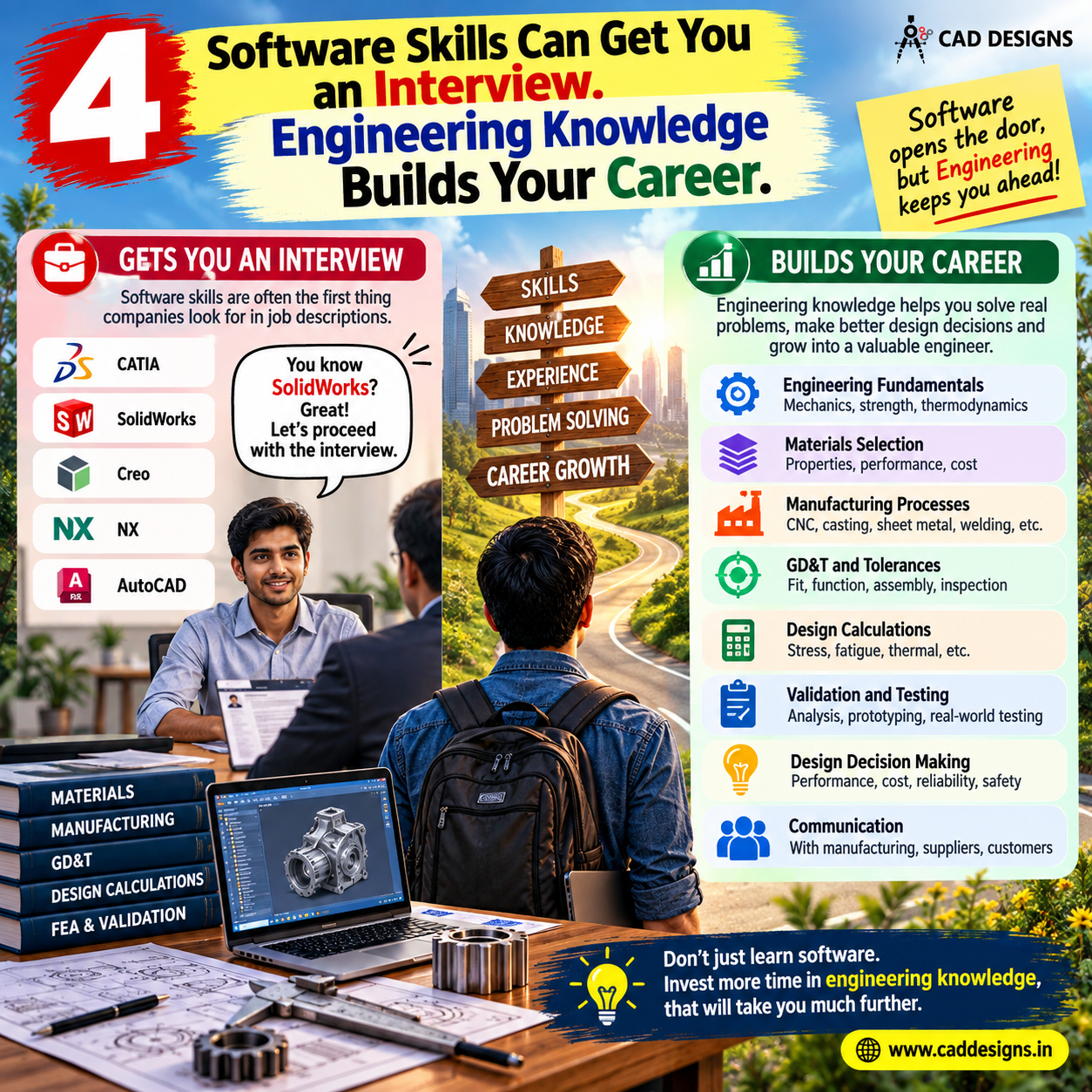
4. Software Skills Get Interviews; Engineering Knowledge Builds Careers

Job descriptions often mention CATIA, Creo, SolidWorks, NX, and AutoCAD. But real industry problems go beyond software commands.

Why did this component fail? Why is the shaft diameter insufficient? Why is the tolerance unnecessarily tight? Can the component be manufactured economically? Why is the bearing failing?

Career Lesson: Learn software, but continuously strengthen your core mechanical engineering knowledge.

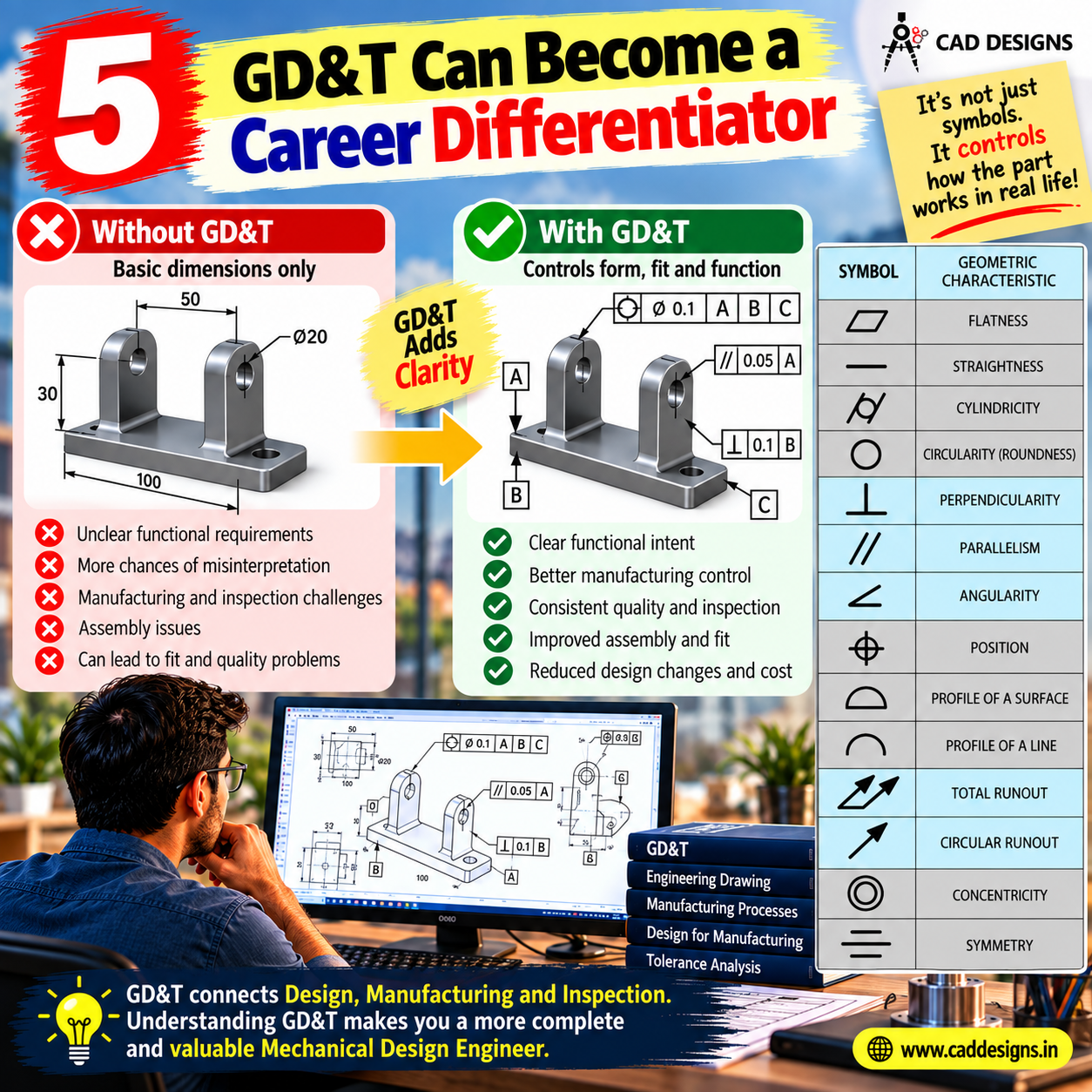
5. GD&T Can Become a Career Differentiator

Many engineers know how to place dimensions on drawings. Far fewer understand how those dimensions control function and assembly.

Strong design engineers understand datums, position, flatness, perpendicularity, parallelism, runout, profile, MMC/LMC, and tolerance stack-up.

Career Lesson: Don’t memorize symbols alone. Understand why a control is required and how it affects manufacturing, inspection, assembly, and cost.

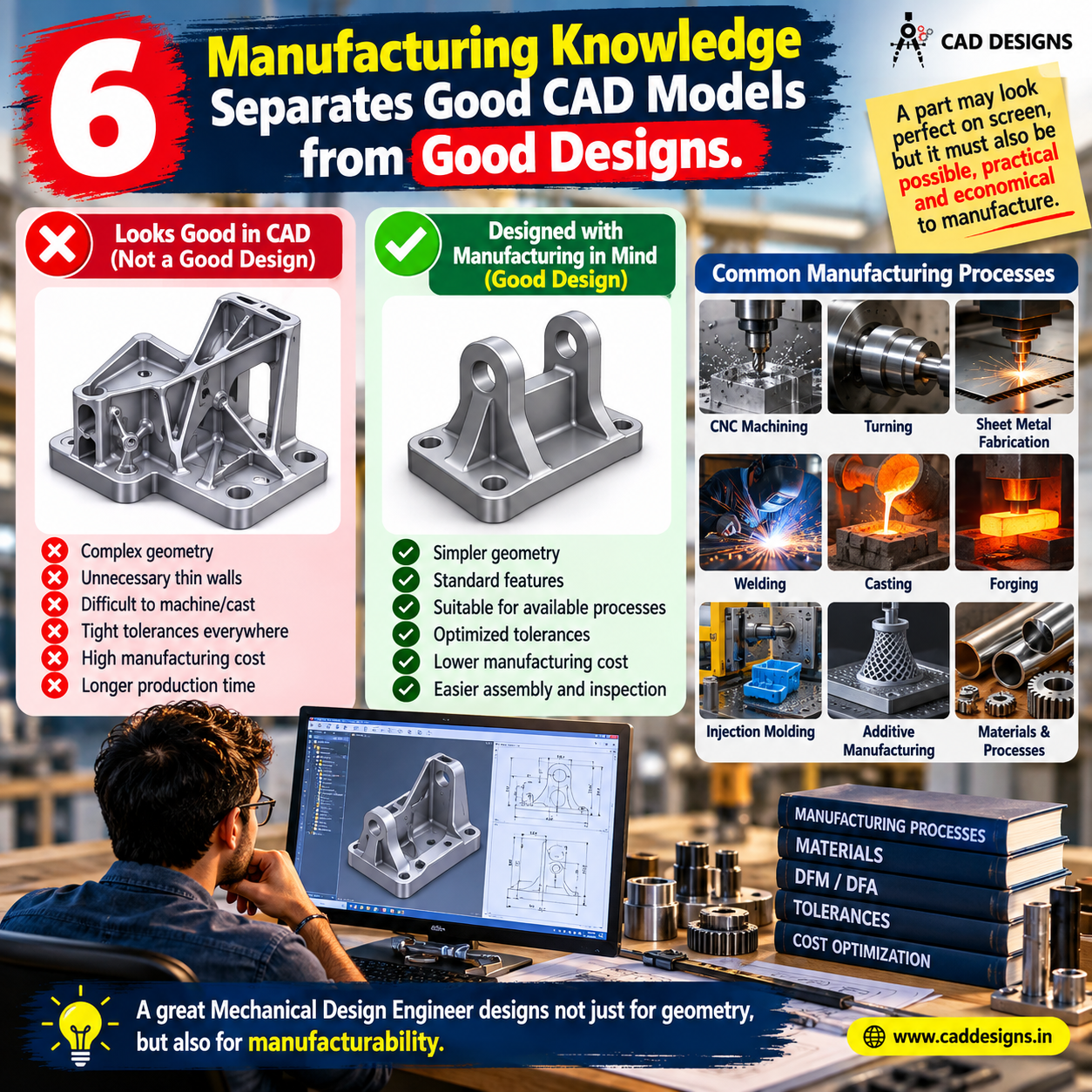
6. Manufacturing Knowledge Separates Good CAD Models from Good Designs

A component can look perfect on a computer screen and still be terrible to manufacture.

Designers should understand CNC machining, turning, milling, sheet-metal fabrication, welding, casting, forging, injection molding, and additive manufacturing.

Career Lesson: Always ask: How will this component actually be manufactured? A great Mechanical Design Engineer designs not just for geometry, but for manufacturability.

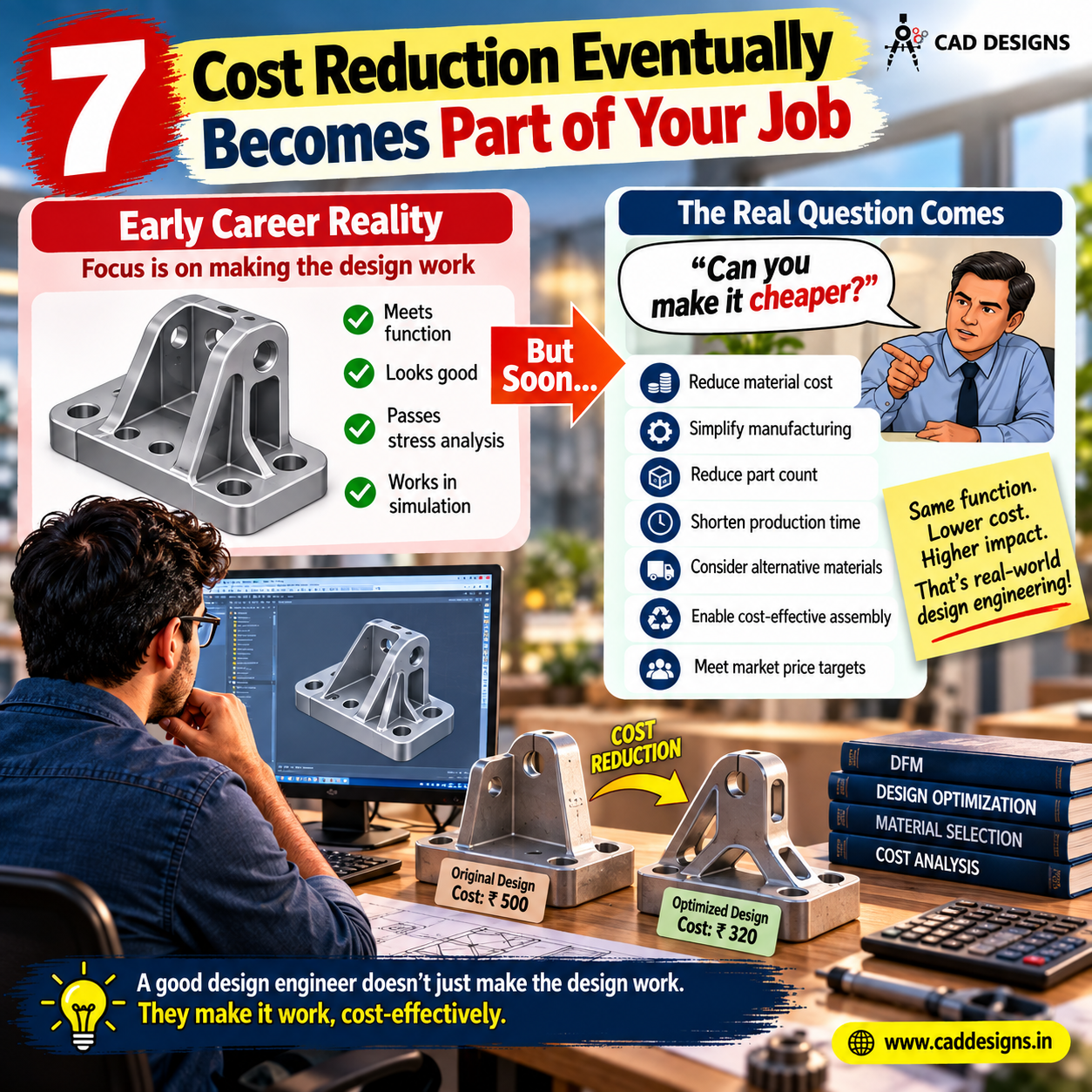
7. Cost Reduction Eventually Becomes Part of Your Job

Young engineers often ask: Will the design work? Experienced engineers are also asked: Can we make it work for less?

Companies care about performance, reliability, manufacturing, assembly, quality, and cost. That means reducing material, eliminating operations, simplifying assemblies, standardizing fasteners, and selecting better processes where possible.

Career Lesson: The ability to reduce cost without compromising safety, function, or reliability is extremely valuable.

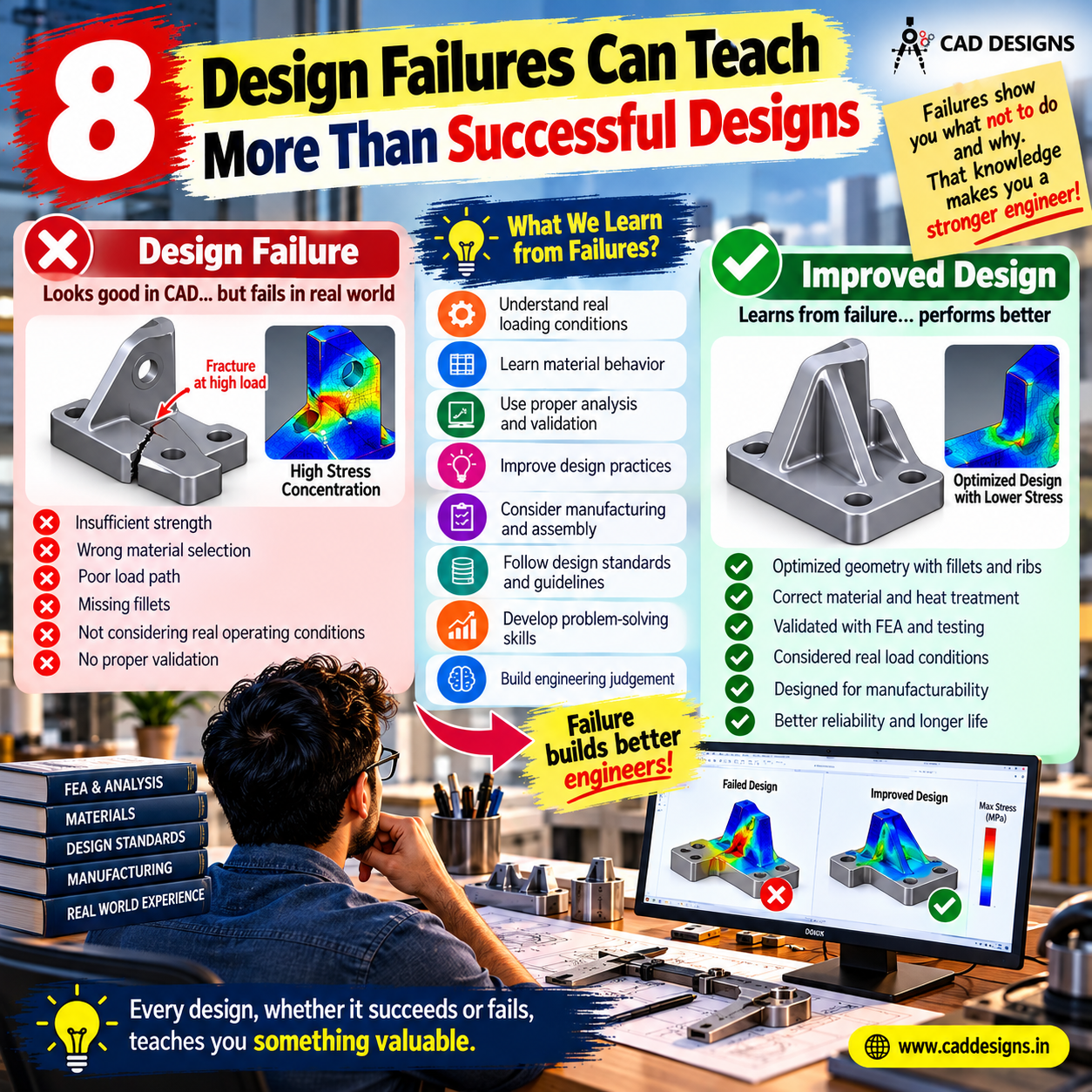
8. Design Failures Can Teach More Than Successful Designs

A bracket cracks. A bearing overheats. A shaft bends. A fastener loosens. A welded structure distorts. These failures are uncomfortable—but they are also where serious engineering learning happens.

Strong engineers ask what failed, where it failed, why it failed, which assumption was wrong, and how to prevent recurrence. Root Cause Analysis, FMEA, and Design Reviews become critical.

Career Lesson: Don’t just fix failed parts. Understand the failure mechanism.

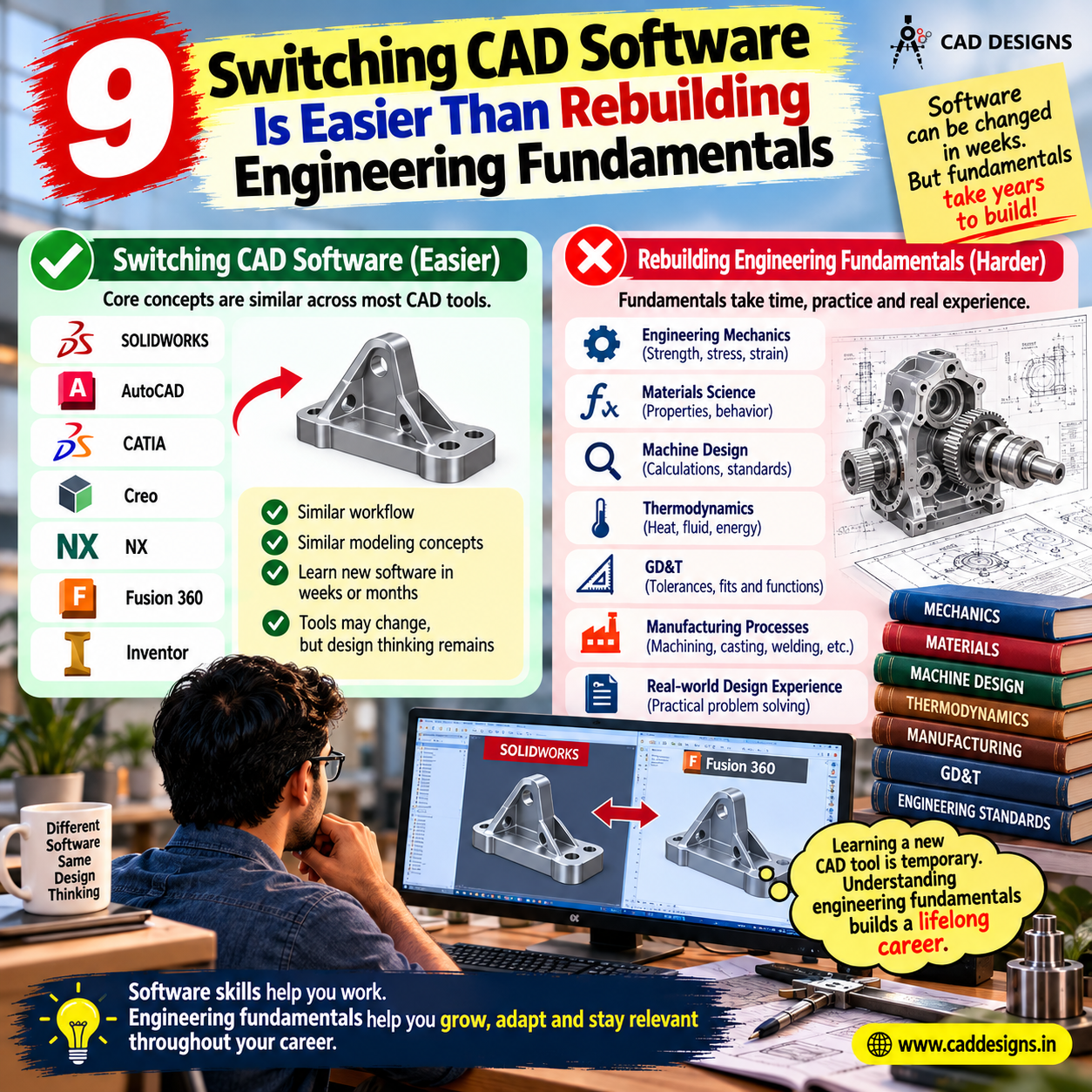
9. Switching CAD Software Is Easier Than Rebuilding Engineering Fundamentals

A SolidWorks engineer may see a Creo requirement. A CATIA engineer may see NX and immediately think, I’m not qualified.

But experienced engineers who understand parametric modeling, assemblies, drawings, GD&T, DFM/DFA, materials, manufacturing, and design calculations can usually learn another platform.

Career Lesson: Software changes. Engineering fundamentals transfer.

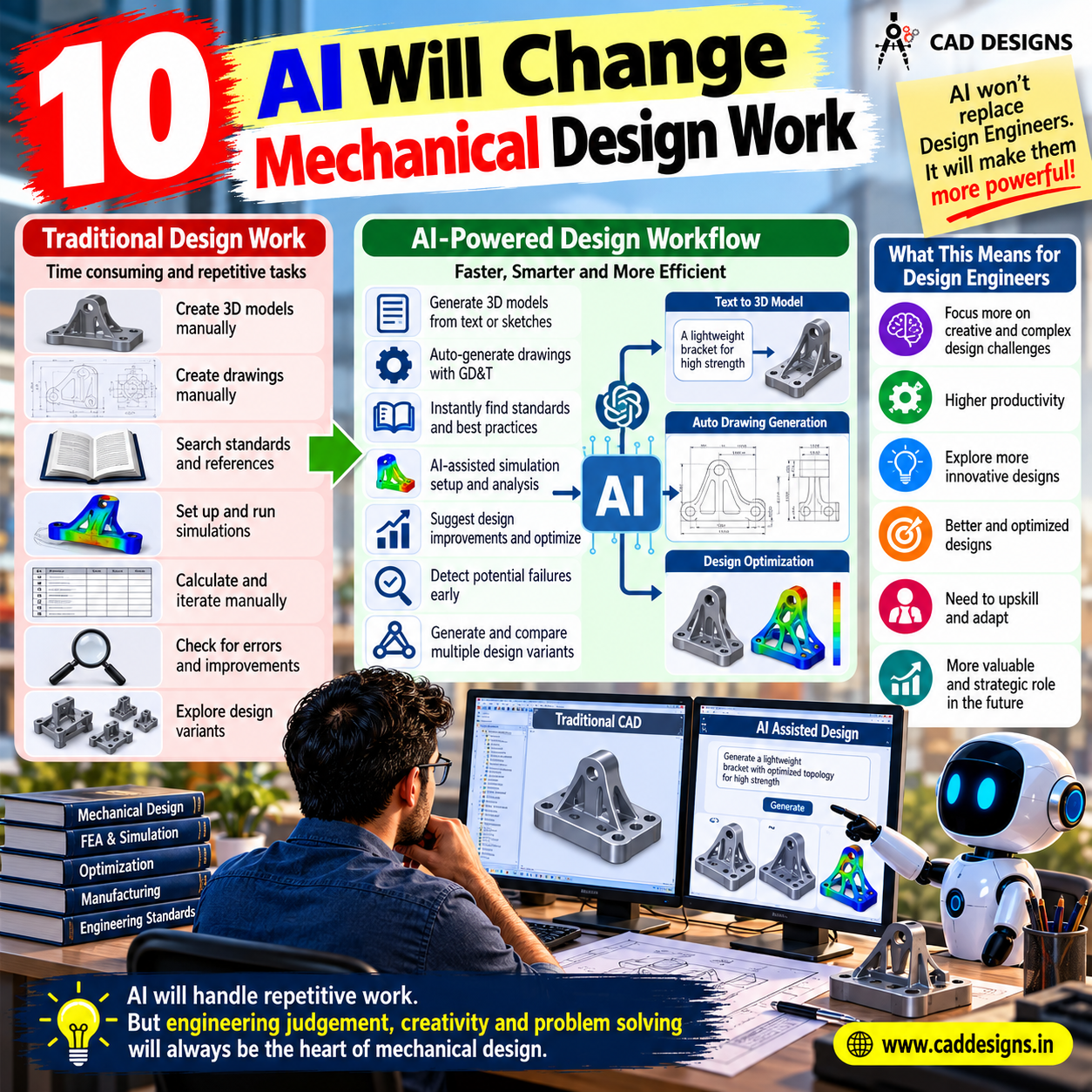
10. AI Will Change Mechanical Design Work

AI and automation are becoming part of engineering workflows. Repetitive modeling, drawing assistance, documentation, design exploration, optimization, and knowledge retrieval will increasingly be automated or accelerated.

The valuable engineer will increasingly be the person who can define the problem, establish constraints, evaluate alternatives, validate results, and make engineering decisions.

Career Lesson: Don’t compete with automation at repetitive work. Learn how to use AI and automation to become a better engineer.

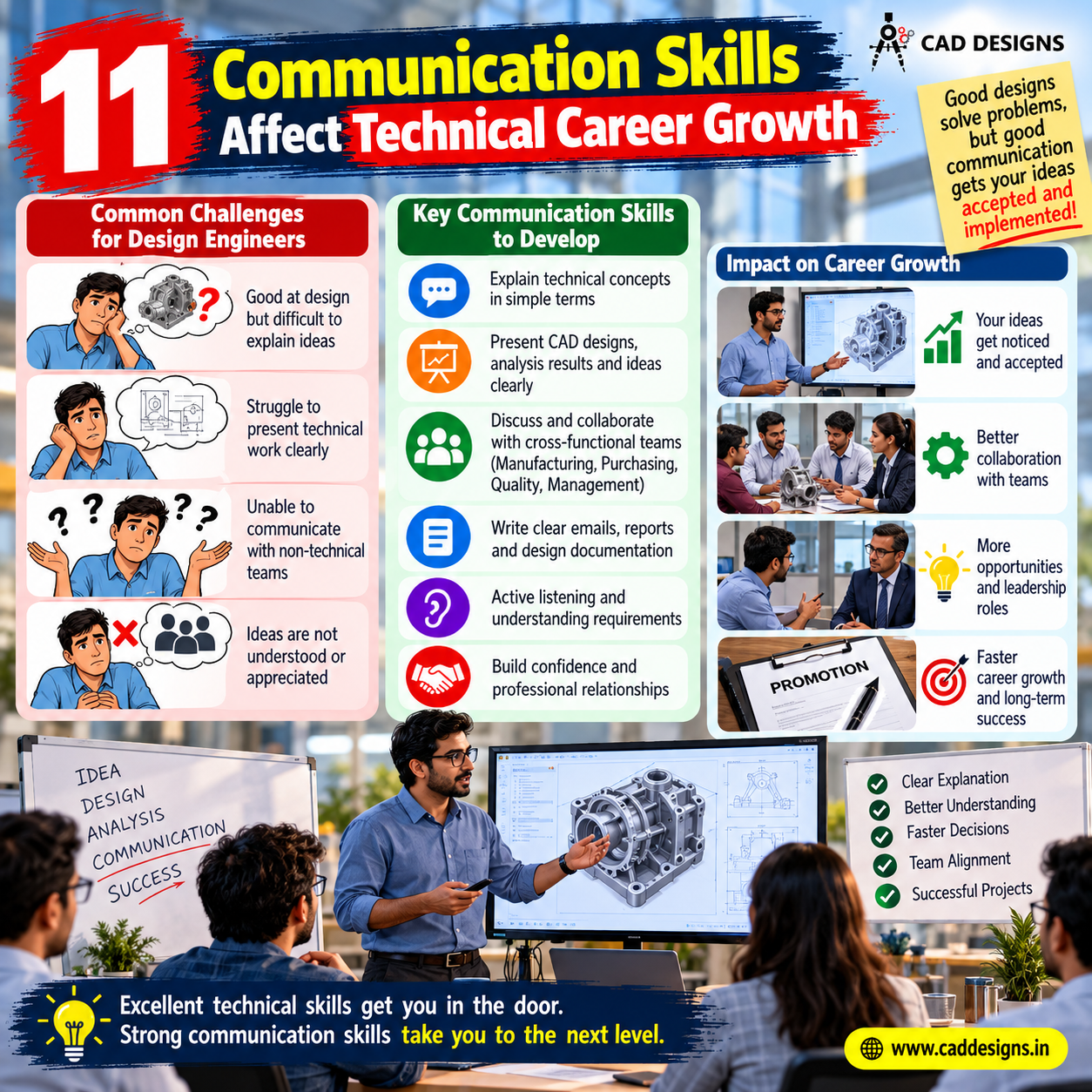
11. Communication Skills Affect Technical Career Growth

You may have an excellent design idea, but eventually you must explain it to senior engineers, manufacturing teams, suppliers, quality engineers, customers, and managers.

You may need to defend material selection, tolerance decisions, design changes, manufacturing methods, cost improvements, and test results.

Career Lesson: Technical knowledge becomes more valuable when you can communicate it clearly and defend it with engineering reasoning.

12. Your Company Is Not Solely Responsible for Your Career Growth

Your employer may provide projects, software, training, mentors, and technical exposure. But ultimately, your career belongs to you.

Build your own learning roadmap: CAD → GD&T → Materials → Manufacturing → Design Calculations → FEA → DFM/DFA → Tolerance Analysis → Failure Analysis → PLM → Automation → AI-Assisted Engineering.

Career Lesson: Your job provides experience. You are responsible for converting that experience into expertise.

The Most Important Reality

The Mechanical Design Engineer who grows fastest is not necessarily the engineer who knows the most CAD commands. It is usually the engineer who can answer: Why was it designed this way? Will it work? Will it fail? Can we manufacture it? Can we assemble and inspect it? Can we make it cheaper? Can we make it better?

That transition—from drawing components to making engineering decisions—is where real career growth happens.

⚙️ A Simple Mechanical Design Career Growth Roadmap

Stage 1 — CAD User
Learn modeling, assemblies, and engineering drawings.

Stage 2 — Design Engineer
Learn materials, manufacturing, GD&T, calculations, and design standards.

Stage 3 — Product Engineer
Understand DFM/DFA, testing, validation, cost, and failure analysis.

Stage 4 — Senior Design Engineer
Take ownership of complete components, systems, and engineering decisions.

Stage 5 — Technical Lead / Design Lead
Guide engineers, review designs, manage technical risks, and make architecture-level decisions.

Stage 6 — Engineering Expert / Manager
Choose deeper technical specialization or engineering leadership.

Final Thought

A Mechanical Design Engineer’s career should not be measured only by Years of Experience.

It should be measured by Problems Solved + Engineering Decisions Made + Products Improved + Failures Understood + Knowledge Gained.

Don’t aim to become someone who simply knows how to create a model. Aim to become the engineer people approach when they ask: “How should we design this?”

That is when CAD becomes more than software. That is when design becomes engineering.


CAD DESIGNS

Learn Mechanical Design. Improve Your Engineering Skills. Build Your Career.

Visit: www.caddesigns.in

Leave a Reply

Your email address will not be published. Required fields are marked *