
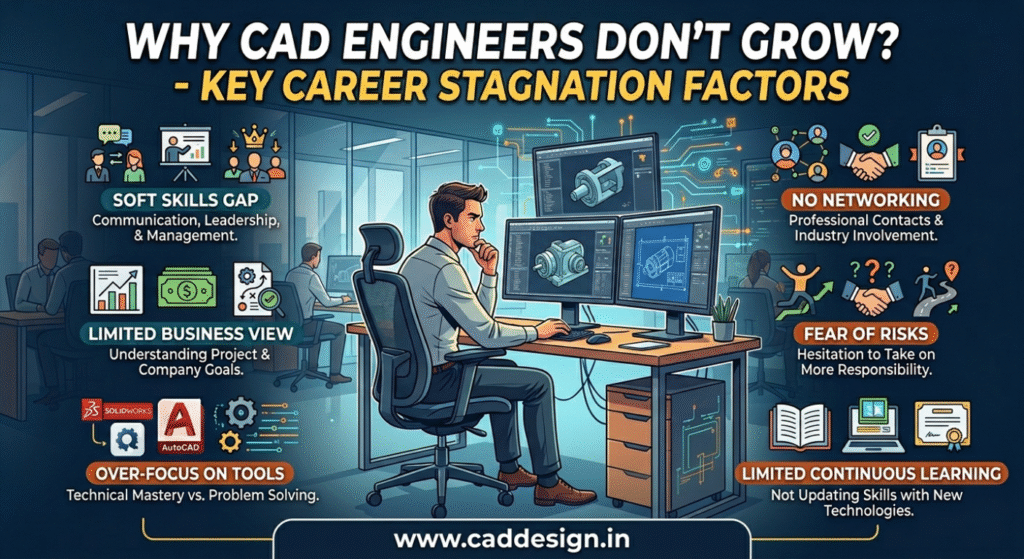
Many CAD engineers start their career with strong enthusiasm. They learn tools like AutoCAD, SolidWorks, CATIA, Creo, or NX and become good at modeling, drafting, and detailing. But after a few years, many feel stuck in the same role, same salary range, and same type of work.
The main reason is simple: they remain only software operators instead of becoming design engineers.
1. Learning Only Commands, Not Engineering Concepts
Knowing CAD commands is important, but growth does not come only from using tools. A CAD engineer must understand:
Manufacturing processes
Material selection
GD&T
Tolerance stack-up
Design for assembly
Design for manufacturing
Product function and failure modes
A model may look perfect on screen, but if it cannot be manufactured, assembled, or used properly, it is not good design.
2. Not Understanding the “Why” Behind Design
Many engineers simply follow instructions:
“Make this drawing.”
“Modify this part.”
“Update this assembly.”
But growing engineers ask:
“Why is this feature required?”
“What problem is this design solving?”
“Can this be simplified?”
“Will this reduce cost or weight?”
“Is this suitable for manufacturing?”
The ability to question and improve design separates a CAD operator from a real design engineer.
3. Poor Drawing and GD&T Knowledge
Engineering drawings are the language of manufacturing. If a CAD engineer cannot create clear drawings with proper dimensions, tolerances, fits, surface finish, and GD&T, growth becomes limited.
A strong CAD engineer should know how to communicate design intent clearly through drawings.
4. Lack of Domain Knowledge
CAD software is only a tool. Real career growth comes when you understand your industry domain, such as:
Automotive
Aerospace
Heavy machinery
Sheet metal
Plastic product design
Power generation
Tooling
Industrial equipment
Domain knowledge helps engineers make better design decisions and become valuable to companies.
5. Not Improving Communication Skills
Technical skills are important, but communication is equally important. Engineers must explain their design ideas, discuss with manufacturing teams, attend reviews, and present solutions confidently.
If you cannot explain your work clearly, your growth may slow down.
6. Avoiding Responsibility
Some CAD engineers only complete assigned tasks and avoid ownership. But companies promote people who take responsibility.
Growth comes when you start handling:
Complete assemblies
Design calculations
BOM creation
Design reviews
Customer requirements
Manufacturing issues
Cost reduction ideas
Ownership builds trust.
7. Not Updating Skills
The industry is changing fast. CAD engineers should continuously learn new skills like:
PLM tools such as Teamcenter or Windchill
Simulation basics
Design automation
Additive manufacturing
Reverse engineering
Product lifecycle management
AI tools for engineering productivity
Continuous learning keeps your career moving forward.
How CAD Engineers Can Grow
To grow as a CAD engineer, focus on becoming a complete design professional. Learn software, but also learn engineering fundamentals. Understand manufacturing. Improve GD&T. Build domain knowledge. Communicate clearly. Take ownership. Keep learning.
Final Thought
CAD is not just about creating 3D models. It is about converting ideas into practical, manufacturable, and reliable products.
Don’t become only a CAD operator. Become a problem-solving design engineer.
Regards
CAD DESIGNS